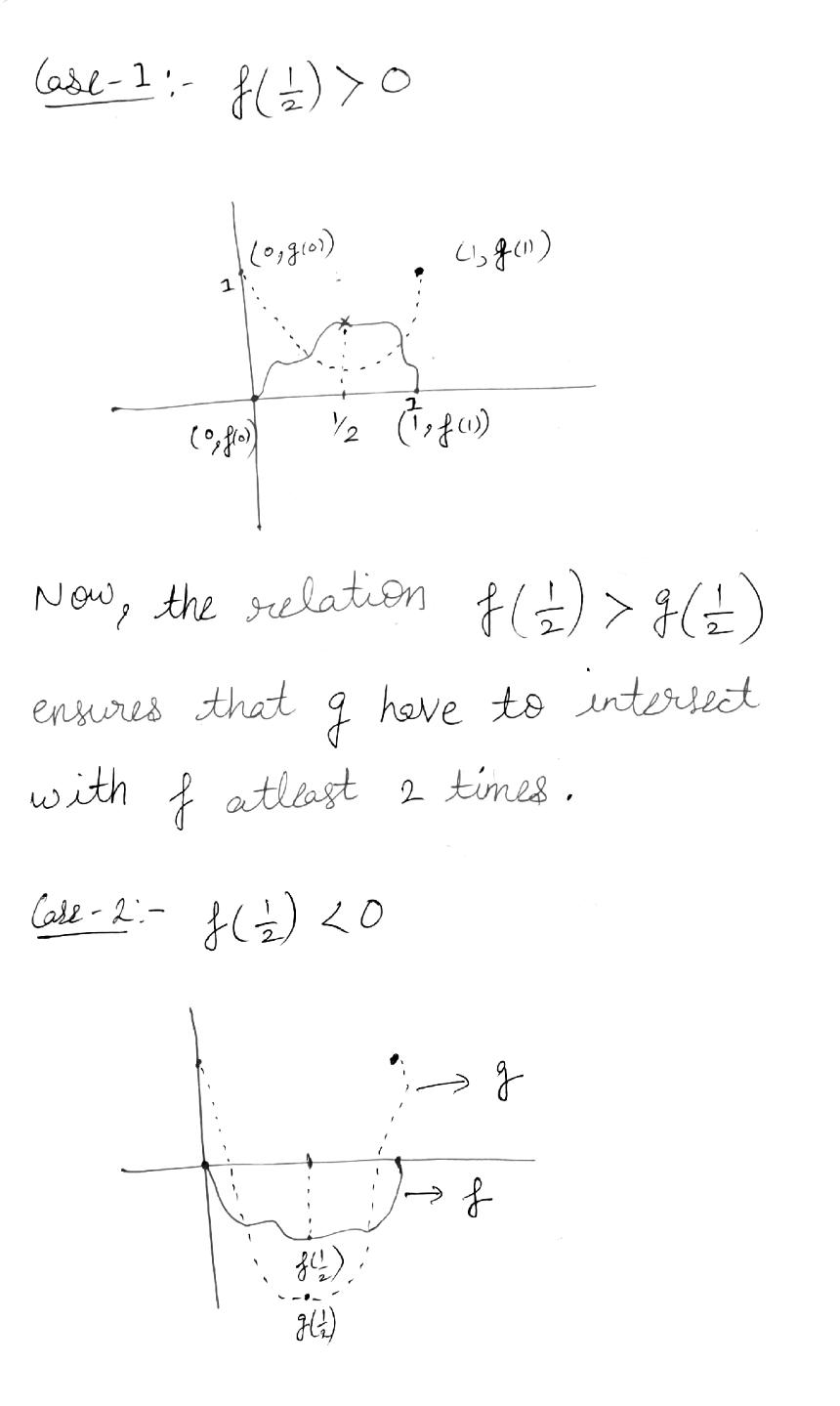
Given f,g are continuous functions on [0,1] such that f(0)=f(1)=0,g(0)=g(1)=1,and f(1/2)>g(1/2).Which of the following statements is true?
A.
There is no, t∈[0,1] such that f(t)=g(t) .
B.
there is exactly one t∈[0,1] such that f(t)=g(t) .
C.
There are at least two t∈[0,1] such that f(t)=g(t) .
D.
There are always infinitely many t∈[0,1] such that f(t)=g(t) .
Correct option is C
Given f,g are continuous functions on [0,1] such that f(0)=f(1)=0,g(0)=g(1)=1,and f(21)>g(21).Now, if f(21)>g(21), then the curve of f will intersect with the curve of g at least 2 times.This can be visualized with the help of rough diagrams of curves of f and g as follows: