






Correct option is B
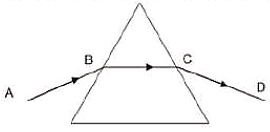
Ans. (b) AB and CD
Explanation:
- In the given figure, an incident ray (AB) enters a triangular prism at point B. This is the initial path of light as it moves from air into the prism.
- After passing through the prism, the ray undergoes refraction and emerges from point C as the emergent ray (CD).
- Therefore, AB is the incident ray, and CD is the emergent ray.
Important Key Points:
- AB represents the incident ray as it enters the prism.
- CD represents the emergent ray as it exits the prism.
- Light refracts when entering and exiting the prism due to a change in medium.
- Refraction at B causes a slight bend in the light’s path as it enters the prism.
- The emergent ray CD is displaced from the original path A due to the prism's refractive properties.
- Prisms are often used to analyze refraction and dispersion in light.
Information Booster:
- Incident Ray: The ray of light that strikes a surface, in this case, the side of the prism.
- Emergent Ray: The ray of light that exits from the opposite side of the prism.
- Refraction: The bending of light as it passes from one medium to another, governed by Snell’s law.
- Dispersion: Prisms can also separate white light into its constituent colors, though dispersion is not depicted in this case.
 English
 100 Questions
 100 Marks
 90 Mins


