






Correct option is B
The steps for applying the Chi-square test of association are as follows:
1. (b) Set up the Null Hypothesis:
· Formulate the null hypothesis (H₀) stating there is no association between the two characteristics being tested.
2. (c) Tabulate data in the contingency table:
· Organize the observed frequency data into a contingency table.
3. (E) Calculate the expected frequencies:
· Compute the expected frequencies using the formula:

4. (d) Divide square difference of expected frequency from observed frequency and add the values at each data point:
· For each cell, calculate:

· Sum up all the calculated values.
5. (a) Compare the calculated value of X²-statistic with the tabulated value:
· Compare the calculated Chi-square value to the critical (tabulated) Chi-square value to decide whether to reject or fail to reject the null hypothesis.
Thus, the correct sequence is B, C, E, D, A.
Information Booster 1. Chi-square Test:
· Used to test the independence of two categorical variables in a contingency table.
2. Null Hypothesis (H₀):
· Assumes no association between the variables.
3. Expected Frequency:
· The theoretical frequency you would expect in each cell if the null hypothesis is true.
4. Chi-square Statistic Formula:
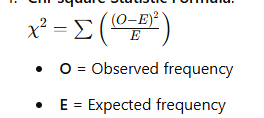
5. Degrees of Freedom (df):
· For a contingency table, calculated as: df=(r−1)×(c−1)
· r = Number of rows
· c = Number of columns
Additional Knowledge · (a) Compare the calculated value: This is the final step to determine if the result is statistically significant.
· (b) Set up the Null Hypothesis: Hypothesizing no relationship between the variables.
· (c) Tabulate Data: Organizing the observed data systematically.
· (d) Square Difference Calculation: This step is the essence of calculating the Chi-square value.
· (E) Calculate Expected Frequencies: These provide the baseline for comparison with observed frequencies.
 English
 10 Questions
 20 Marks
 12 Mins


