Correct option is B
Explanation:
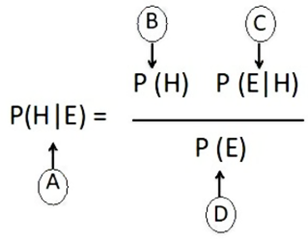
The given equation is Bayes' Theorem, which describes the probability of a hypothesis given observed data. It is written as:
where:
· P(H1∣D) → Posterior probability (Probability of H1 after observing data X).
· P(H1) → Prior probability (Initial belief about H1 before seeing data).
· P(X∣H1) → Likelihood (Probability of data X given H1).
· P(X) → Evidence (Marginal likelihood) (Overall probability of observing X across all hypotheses).
Evaluating the statements:
Statement A is correct:
- P(H1∣D) is the posterior probability, which represents the probability of hypothesis H1 given the observed data D.
Statement B is incorrect:
- P(X∣H1) represents the likelihood of the data given the hypothesis, not the probability of the data itself.
- The probability of the data is given by P(X) , also known as marginal likelihood or evidence.
Statement C is incorrect:
- P(X∣H1) is not the prior probability. Instead, P(H1) is the prior probability.
- The prior probability is our belief about the hypothesis before seeing data.
Statement D is correct:
- P(X∣H1) is the likelihood, which measures how well hypothesis H1 explains the observed data X.