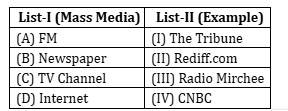
Correct option is A
In
conventional media such as newspapers, radio, or television, there is typically a
temporal separation between the production of content and its consumption by the audience. This separation arises because:
1. Content creation, editing, and packaging take place before it is broadcast, published, or aired.
2. The audience accesses the content later when it is delivered through the specific medium (e.g., a newspaper in the morning or a pre-recorded television program).
For instance:
· A newspaper article is written, edited, and printed hours before it is read.
· A radio program is often pre-recorded and aired at a later time.
Thus,
temporal separation is a defining characteristic of traditional media, distinguishing it from newer digital platforms where real-time content production and consumption are possible.
Information Booster:
1.
Conventional media refers to platforms like newspapers, magazines, radio, and television that predate digital media.
2. Temporal separation is reduced in
digital media due to advancements in technology that allow for live broadcasts, instant uploads, and real-time interaction.
3. Traditional media is often limited by fixed schedules (e.g., TV shows airing at set times).
4. The delay between production and consumption affects audience engagement and feedback.
5. Digital media’s real-time nature has challenged and reshaped how conventional media operates.
Additional Knowledge:
·
Option (b): Imaginary hurdles Incorrect. There are no "imaginary hurdles" inherent to conventional media; challenges are mostly logistical or technical.
·
Option (c): Free marketing Incorrect. While conventional media can include marketing elements, it is not a defining feature of the production-consumption process.
·
Option (d): Technological over-dependence Incorrect. Conventional media, unlike digital media, relies on simpler and more established technologies, making over-dependence less of an issue.
 English
 10 Questions
 20 Marks
 12 Mins