






Correct option is C
The Mode is the measure of central tendency that represents the most frequently occurring value in a dataset. In the case of a frequency distribution table with equally spaced class intervals, three class interval frequencies are required to estimate the mode accurately:
1. Modal Class: The class interval with the highest frequency.
2. Preceding Class: The class interval that comes immediately before the modal class.
3. Succeeding Class: The class interval that comes immediately after the modal class.
The formula used for estimating the mode in a grouped frequency distribution is:
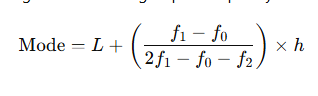
Where:
· L = Lower boundary of the modal class
· f₁ = Frequency of the modal class
· f₀ = Frequency of the class preceding the modal class
· f₂ = Frequency of the class succeeding the modal class
· h = Class interval width
This formula clearly shows the need for three frequencies: f0, f1, and f2.
Information Booster 1. Mode is particularly useful in categorical data where the mean and median are not meaningful.
2. Bimodal and Multimodal distributions have more than one mode.
3. Mode vs. Mean and Median: The mode is less affected by extreme values compared to the mean.
4. Applications: Commonly used in market analysis, fashion trends, and demographic studies.
5. Mode in Ungrouped Data: The value that appears most frequently in a dataset.
Additional Knowledge · (a) Mean: The sum of all values divided by the number of values. Requires all data points for calculation and is sensitive to outliers.
· (b) Median: The middle value of a dataset when arranged in ascending order. For grouped data, the median can be calculated using the cumulative frequency approach and requires identifying the class interval containing the median position.
· (c) Mode: The most frequent value. For grouped data, it relies on the frequencies of three class intervals (preceding, modal, and succeeding classes).
· (d) Harmonic Mean: The reciprocal of the arithmetic mean of the reciprocals of the data values. It is used for datasets involving rates and ratios.
 English
 10 Questions
 20 Marks
 12 Mins


