Correct option is D
Flame photometry is a type of atomic emission spectroscopy. It is also known as flame emission spectroscopy. A photoelectric flame photometer is an instrument used in inorganic chemical analysis to determine the concentration of certain metal ions, among them sodium, potassium, lithium, and calcium. Group 1 (alkali metals) and Group 2 (alkaline earth metals) are quite sensitive to flame photometry due to their low excitation energies.
In principle, it is a controlled flame test with the intensity of the flame color quantified by photoelectric circuitry. The intensity of the color will depend on the energy that had been absorbed by the atoms that was sufficient to vaporise them. The sample is introduced to the flame at a constant rate. Filters select which colours the photometer detects and exclude the influence of other ions. Before use, the device requires calibration with a series of standard solutions of the ion to be tested.
The basis of flame photometric working is that, the species of alkali metals (Group 1) and alkaline earth metals (Group II) metals are dissociated due to the thermal energy provided by the flame source. Due to this thermal excitation, some of the atoms are excited to a higher energy level where they are not stable. The absorbance of light due to the electrons excitation can be measured by using the direct absorption techniques. The subsequent loss of energy will result in the movement of excited atoms to the low energy ground state with emission of some radiations, which can be visualized in the visible region of the spectrum. The absorbance of light due to the electrons excitation can be measured by using the direct absorption techniques while the emitting radiation intensity is measured using the emission techniques. The wavelength of emitted light is specific for specific elements.
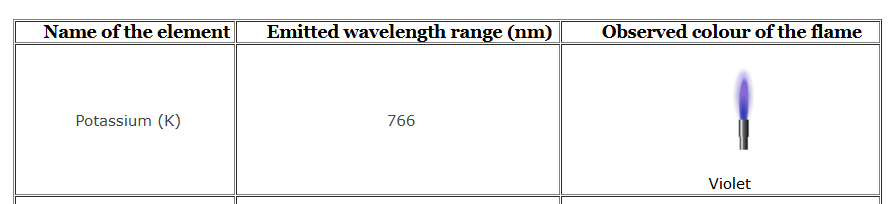
The band at 766 nm in flame photometry is due to the emission from neutral potassium atoms. When a potassium ion (e.g., from a blood serum sample) is introduced into the flame, the heat causes the potassium ions to convert into neutral potassium atoms. These neutral atoms are then excited to a higher energy state due to the thermal energy of the flame. As they return to their ground state, they emit light at specific characteristic wavelengths, one of which is 766 nm. This emission is used to detect potassium in flame photometric analysis.