






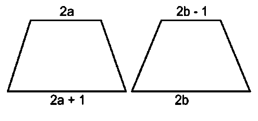
Correct option is B
Solution:
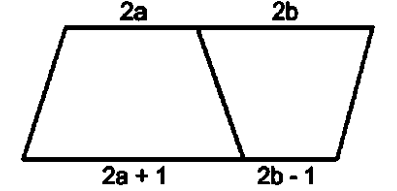
When we add both trapeziums, we form a parallelogram as shown in the figure.
Formula:
The area of a trapezium is given as: Area = (1/2) × height × (sum of parallel sides).
For the parallelogram formed by combining two trapeziums, its total area is already given as
2(a + b).
Calculation:
Parallel sides of the parallelogram:
Adding the bases of the two trapeziums: Parallel sides = (2a + 2b).
Area of the parallelogram: The formula for the area of a parallelogram is: Area = Base × Height.
Substituting values: 2(a + b) = (1/2) × height × (2a + 2b + 2a + 2b).
Simplify the terms: 2(a + b) = (1/2) × height × 4(a + b).
Further simplify: 2(a + b) = height × 2(a + b).
Solve for height: height = [2(a + b)] / [2(a + b)] = 1.
Conclusion:
The height of the parallelogram is
1.


