Correct option is A
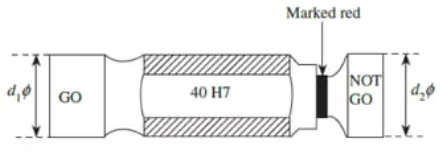
Limit gauges are precision tools used to check whether a manufactured part's dimensions fall within specified tolerance limits. The "GO" gauge checks the
minimum limit (i.e., the part must fit the "GO" gauge), while the "NO GO" gauge checks the
maximum limit (i.e., the part must
not fit the "NO GO" gauge). These gauges are commonly used in mass production for fast and efficient inspection of dimensions.
Purpose of Limit Gauges: To ensure the part is within tolerance limits without using precise measurements.
Working Principle:
GO Gauge: Ensures the part is not too large (acceptance condition).
NO GO Gauge: Ensures the part is not too small (rejection condition).
Applications: Widely used in quality control to inspect shafts, holes, and threads.
Types of Limit Gauges:
·
Plug Gauges: Used to check holes.
·
Snap Gauges: Used to check external dimensions like shafts.