arrow
arrow
arrow
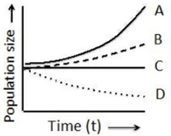
For a population that grows exponentially in the time interval (t, t+1), we have Nt Nt+1=RNtN_{t+1} = R N_t+1=RNt, where NNN denotes population s
Question

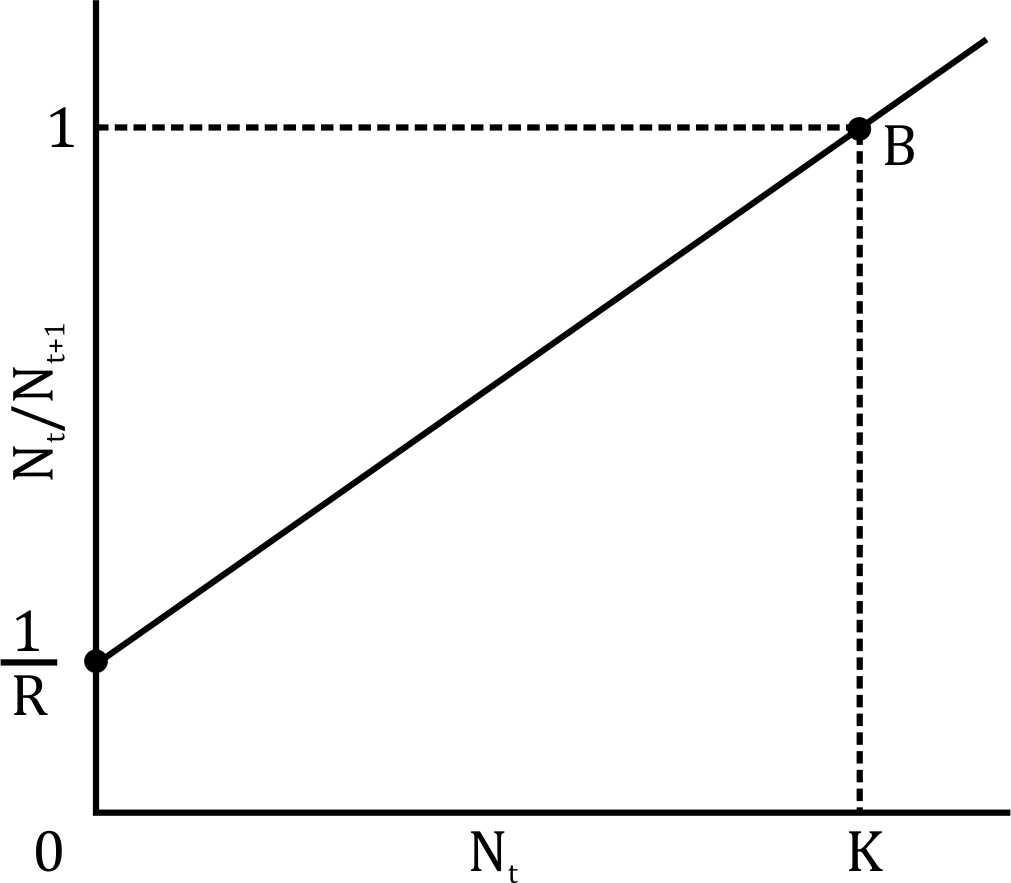
For a population that grows exponentially in the time interval (t, t+1), we have Nt Nt+1=RNtN_{t+1} = R N_t+1=RNt, where NNN denotes population size and RRR denotes the growth rate. Under intraspecific competition where births and deaths are density-dependent, we expect the population to stabilize at carrying capacity, KKK. In the figure below, N/ Nt+1 is plotted as a linear function of Nt

We may write down the linear equation for the line joining A with B and derive a model for density-dependent population growth under intraspecific competition. Denoting (R- 1)K as a, which of the following is the correct relationship that describes population growth?​(R−1)K\frac{(R-1)}{K}


A.

Nt+1=NtR(1+aNt)N_{t+1}=\frac {N_tR}{(1+aN_t)}​​

B.

Nt+1=aNt(1+RNt)N_{t+1}=\frac{aNt}{(1+RN_t)}​​

C.

Nt+1=NtR(a+Nt)N_{t+1}=\frac{N_tR}{(a+N_t)}​​

D.

Nt+1=aNtR(1+aNt)N_{t+1}=\frac{aN_tR}{(1+aN_t)}​​

Correct option is A

The given equation describes a population growing exponentially but modified by intraspecific competition, where the growth rate decreases as the population size increases. The linear equation joining A and B in the graph represents the relationship between Nt and NtNt+1\frac{N_{t}}{N_{t+1}} reflecting density-dependent growth.

The general equation for such a model, considering the effect of competition, is given by:
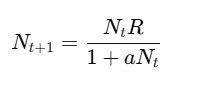
Where:

  • NtN_tNt is the current population size,
  • RRR is the intrinsic growth rate,
  • aaa is a constant that represents the density-dependent competition effect.

This equation implies that as the population size increases, the growth rate slows down due to intraspecific competition, stabilizing when the population reaches the carrying capacity KKK.

Information Booster:

  • Density-Dependent Growth: This occurs when the rate of population growth depends on the population density. As the population increases, resources become limited, and the growth rate decreases.
  • Carrying Capacity KKK: The carrying capacity is the maximum population size that the environment can sustain. At this point, the growth rate becomes zero because the resources are fully utilized.
  • Parameter aaa: In the equation (R1)K\frac{(R-1)}{K}​, aaa represents the strength of density dependence. It influences how quickly the growth rate slows as the population size increases.
  • Exponential Growth: The equationNt+1=RNtN_{t+1} = R N_tNt+1=RNt represents exponential growth, where the population increases without any limitations. The presence of density dependence modifies this equation to reflect more realistic population dynamics.
  • Population Stabilization: The equation Nt+1N{t+1} = NtR1+aNt\frac{N_tR}{1+aN_t} models a population that initially grows exponentially but then slows as it approaches carrying capacity, eventually stabilizing.
Similar Questions

test-prime-package

Access ‘CSIR NET Life Sciences’ Mock Tests with

  • 60000+ Mocks and Previous Year Papers
  • Unlimited Re-Attempts
  • Personalised Report Card
  • 500% Refund on Final Selection
  • Largest Community
students-icon
353k+ students have already unlocked exclusive benefits with Test Prime!
test-prime-package

Access ‘CSIR NET Life Sciences’ Mock Tests with

  • 60000+ Mocks and Previous Year Papers
  • Unlimited Re-Attempts
  • Personalised Report Card
  • 500% Refund on Final Selection
  • Largest Community
students-icon
353k+ students have already unlocked exclusive benefits with Test Prime!
Our Plans
Monthsup-arrow