
Correct option is D
Solution:
- Five classical spins (si=±1s_i = \pm 1si=±1) are placed at the vertices of a regular pentagon.
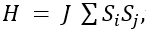
- The Hamiltonian is H=J∑sisjH = J \sum s_i s_jH = J ∑sisj, where J>0J > 0J>0, and the summation is over all nearest-neighbor pairs.
- The system minimizes energy when nearest neighbors are aligned.
- degeneracyThe task is to calculate the of the ground state.
Ground State Condition:
For J>0J > 0J>0, the ground state occurs when all neighboring spins are aligned, minimizing the energy.- If all spins are +1+1+1, then all nearest-neighbor pairs are aligned.
- Similarly, if all spins are −1-1−1, all nearest-neighbor pairs are aligned.
Key Point: There are multiple symmetry-equivalent ways to achieve ground state alignment.
Step-by-Step Explanation of Ground State Degeneracy
1. Total Spins:
- There are 5 spins in the system, each of which can independently be +1+1+1 or −1-1−1.
2. Ground State Configurations:
- For the energy to be minimized, all spins on neighboring vertices must be aligned.
- There are two fundamental configurations:
- All spins +1+1+1.
- All spins −1-1−1.
3. Symmetry Consideration:
- The pentagon has rotational and reflectional symmetry, which leads to degeneracy in equivalent configurations.
4. Counting Unique Configurations:
- 10 distinct equivalent configurationsBy carefully analyzing the arrangement of spins in the pentagon, there are that correspond to the same energy level due to symmetry transformations.
Conclusion
The degeneracy of the ground state is (d) 10.