Correct option is D
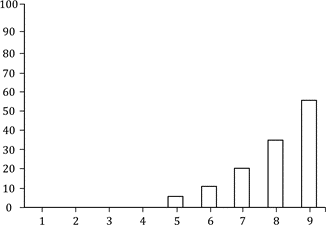
Directional selection is a type of natural selection that favors one extreme phenotype over the other, leading to a shift in the frequency distribution of a trait. This results in a skewed distribution (either left-skewed or right-skewed) depending on which trait is favored.
Directional Selection Affects Trait Distribution
- If selection favors larger traits → Right-skewed distribution (e.g., larger body size in elephants due to predation pressure).
- If selection favors smaller traits → Left-skewed distribution (e.g., smaller beak size in birds if food resources favor it).
- The trait distribution does not remain normal (bell-shaped), as one end of the spectrum is selected against.
Examples of Directional Selection
Peppered Moths (Industrial Melanism)
- Dark-colored (melanic) moths became more common in polluted areas due to better camouflage.
- Shift: Light-colored → Dark-colored (Right-skewed).
Antibiotic Resistance in Bacteria
- Bacteria with higher resistance genes survive, leading to an increase in resistant strains.
- Shift: Non-resistant → Highly resistant (Right-skewed).
Information Booster
Types of Natural Selection:
- Directional Selection – Favors one extreme trait (right- or left-skewed).
- Stabilizing Selection – Favors the average trait (normal distribution).
- Disruptive Selection – Favors both extremes but not the average (bimodal distribution).
Why It Is Skewed:
- The mean trait value shifts towards one direction.
- Variation reduces at the opposite end.
Impact on Evolution:
- Leads to adaptive changes in species over generations.
- Can result in speciation if prolonged.
Additional Information
Option (1) Normally distributed (Incorrect):
- Directional selection shifts the mean, so the distribution is no longer normal.
Option (2) Always left-skewed (Incorrect):
- Directional selection can be left-skewed or right-skewed, depending on which trait is selected.
Option (3) Always right-skewed (Incorrect):
- Selection does not always favor an increase; it can favor decrease as well.