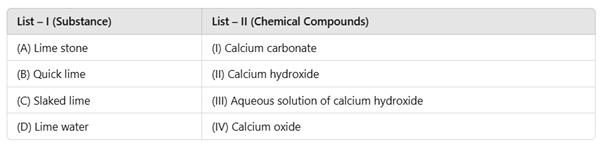
Correct option is C
Explanation The solubility of ammonia in water is influenced by several factors. An increase in temperature generally decreases the solubility of gases in liquids, including ammonia (statement a). A decrease in pH (statement b) will increase the solubility of ammonia because the formation of ammonium ions (NH₄⁺) enhances the dissolution process. An increase in the partial pressure of ammonia (statement c) will also lead to an increase in its solubility in water due to Henry's Law, which states that the solubility of a gas is directly proportional to its partial pressure above the liquid.
Information Booster
· Temperature Effects: Gases typically have reduced solubility at higher temperatures due to increased kinetic energy.
· pH Influence: Lower pH levels increase the concentration of H⁺ ions, promoting the formation of NH₄⁺ ions and thus increasing ammonia solubility.
· Henry's Law: It states that at constant temperature, the amount of gas that dissolves in a liquid is proportional to the partial pressure of that gas in equilibrium with that liquid.
· Chemical Equilibrium: The dissolution and reaction of ammonia with water is an equilibrium process, influenced by changes in conditions.
· Real-World Applications: Understanding ammonia solubility is crucial in various fields such as environmental science, aquaculture, and chemical engineering.
Additional Information
· Ammonia in Water: When dissolved, ammonia can react with water to form ammonium hydroxide (NH₄OH), contributing to its solubility.
· Impact of pH: A decrease in pH increases NH₄⁺ ion concentration, further driving the equilibrium towards more dissolved ammonia.
· Partial Pressure in Industry: In industrial applications, controlling the partial pressure of ammonia can optimize its solubility in water for various processes, including refrigeration and fertilization.
 English
 10 Questions
 20 Marks
 12 Mins