Correct option is C
The correct answer is: (3) Phenotype frequency: Q > (P = R) > S
Explanation:
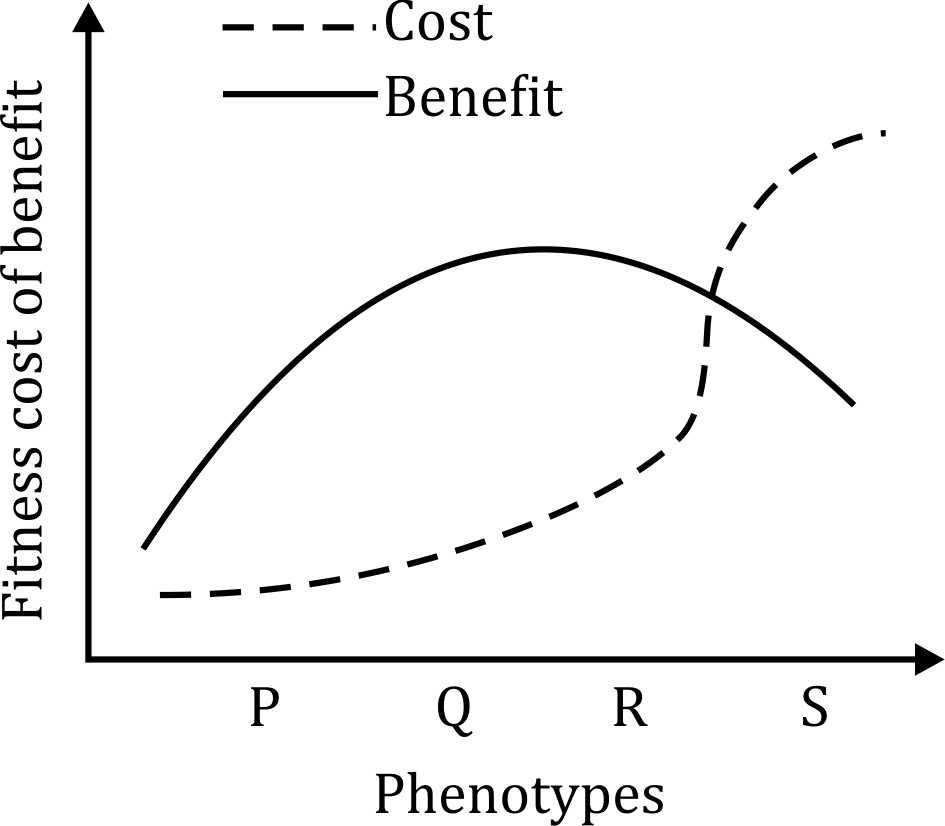
In this case, the fitness cost and benefit functions indicate how the alarm call behavior (based on the loudness of the call) impacts the fitness of the individuals:
Phenotype S produces the loudest alarm calls, but the cost of being more conspicuous to the predator outweighs the benefit. In the graph, the benefit increases up to a point, but the cost increases more rapidly after this point. Therefore, S is less beneficial than Q.
Phenotype Q represents a good balance between cost and benefit, where the fitness benefit outweighs the fitness cost. This leads to Q being the most favored phenotype in the population.
Phenotypes P and R are less fit compared to Q because, while they may have lower costs or higher benefits, the overall fitness value (benefit – cost) is lower. The values for P and R are similar, so they are grouped together.
Thus, the most common phenotypes will be Q > (P = R) > S under natural selection, as Q has the best benefit-to-cost ratio, and S is the least favorable phenotype.
Information Booster:
Natural selection favors the phenotype that maximizes fitness, which is a balance of benefit (alarm call effectiveness) and cost (increased predator conspicuousness).
Phenotype Q has the most favorable balance of benefit and cost, making it the most common under natural selection.
Phenotypes P and R are similarly fit, but they are less favored than Q due to a lower benefit-to-cost ratio.
Phenotype S is the least favored due to its high cost relative to the benefit, making it the least common phenotype.
Additional Information:
Option 1 (P = Q = R < S): This option incorrectly suggests that P, Q, and R are equally fit, which does not match the graph showing a significant advantage for Q.
Option 2 (S > R > Q > P): This suggests that S is the most favored phenotype, which contradicts the graph, as Q is the most favored.
Option 4 (Q > P = R = S): This does not align with the graph, as S should not be equal to P and R in fitness.