

arrow
arrow
arrow
Circular genomic DNA isolated from actively replicating stages of organisms P and Q were digested with a restriction enzyme that cuts both genomes onl
Question

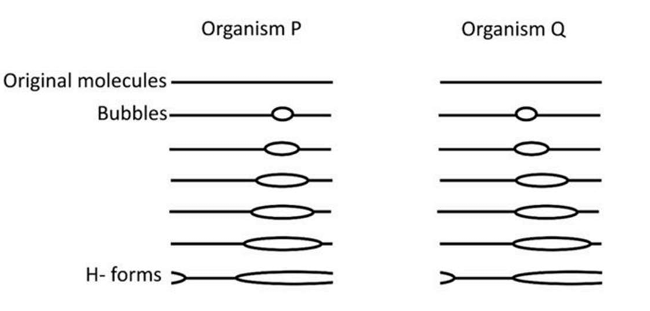
Circular genomic DNA isolated from actively replicating stages of organisms P and Q were digested with a restriction enzyme that cuts both genomes only once. The electron micrographs of the digested DNAs are shown.


Based on these observations, the following comments are made on the number of replication origins and directionality of replication forks:
A. In organism P there are two replication origins, and replication is bidirectional.
B. In organism P there is one replication origin, and replication is bidirectional.
C. In organism Q there is one replication origin, and replication is bidirectional.
D. In organism Q there is one replication origin, and replication is unidirectional.
Which one of the following options represents the combination of all correct statements?

A.

A and C

B.

A and D

C.

B and C

D.

B and D

Correct option is D

Correct Answer:
(d) B and D
Explanation:
After digestion at a single restriction site, circular DNA converts into a linear molecule.
In organism P, the electron micrographs show replication bubbles symmetrically positioned and H-forms consistent with two replication forks moving away from a single origin → one origin, bidirectional replication (B correct).
In organism Q, replication intermediates show asymmetric bubble growth and H-forms consistent with only one moving fork → one origin, unidirectional replication (D correct).
Information Booster :
· Bubble-shaped intermediates indicate active DNA replication.
· Symmetric bubbles arise from bidirectional fork movement.
· Asymmetric structures indicate unidirectional replication.
· Single-cut restriction digestion is a classic method to infer replication dynamics.
Additional Information (Incorrect Options):
Statement A: Incorrect—there is no evidence of two replication origins in organism P.
Statement C: Incorrect—organism Q does not show bidirectional replication patterns.
Hence, options containing A or C are incorrect.

Similar Questions

test-prime-package

Access ‘CSIR NET Life Sciences’ Mock Tests with

  • 60000+ Mocks and Previous Year Papers
  • Unlimited Re-Attempts
  • Personalised Report Card
  • 500% Refund on Final Selection
  • Largest Community
students-icon
353k+ students have already unlocked exclusive benefits with Test Prime!
test-prime-package

Access ‘CSIR NET Life Sciences’ Mock Tests with

  • 60000+ Mocks and Previous Year Papers
  • Unlimited Re-Attempts
  • Personalised Report Card
  • 500% Refund on Final Selection
  • Largest Community
students-icon
353k+ students have already unlocked exclusive benefits with Test Prime!
Our Plans
Monthsup-arrow
