Correct option is D
EXPLANATION-
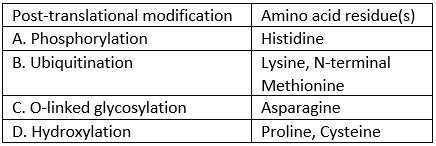
A - Phosphorylation is a common modification where a phosphate group is added to amino acids.
The most typical amino acids phosphorylated are Serine (Ser), Threonine (Thr), and Tyrosine (Tyr).
However, phosphorylation on Histidine is also well-documented, especially in prokaryotes and some eukaryotic signaling pathways (e.g., two-component systems).
So, this is correct.
B - Ubiquitination involves attaching ubiquitin protein primarily to the epsilon-amino group of Lysine residues on target proteins.
Sometimes, ubiquitin can also be attached to the N-terminal methionine of a protein.
Hence, the match with Lysine and N-terminal methionine is correct.
So, this is correct.
C - O-linked glycosylation commonly occurs on the hydroxyl group of Serine or Threonine residues, not on Asparagine.
Asparagine is the site for N-linked glycosylation, not O-linked.
Therefore, this is incorrect.
D - Hydroxylation typically occurs on Proline and Lysine residues, particularly important in collagen stability.
Cysteine is not a common target of hydroxylation.
Thus, this is incorrect due to Cysteine.
So, the correct option is (d) - A and B only