Correct option is C
Explanation:
- Bacteriophage λ and P1 are both temperate phages, meaning they can undergo either lytic or lysogenic cycles in E. coli. However, their lysogenic states differ significantly.
Statement 1: Correct
- Both λ (lambda) phage and P1 phage are double-stranded DNA (dsDNA) viruses, meaning they have a dsDNA genome.
- This characteristic is common among many temperate phages.
Statement 2: Correct
- In their lysogenic state:
- λ phage integrates into the E. coli genome as a prophage.
- P1 phage, however, does not integrate into the genome. Instead, it remains as a low-copy-number plasmid, autonomously replicating within the host cell.
- This statement correctly distinguishes between the behaviors of λ and P1 phages.
- In their lysogenic state:
Statement 3: Incorrect
- The λ phage integrates into the bacterial chromosome as a prophage in lysogeny.
- P1 phage does not integrate into the genome but persists as a plasmid.
- Since this statement incorrectly states that both phages integrate, it is incorrect.
Statement 4: Correct
- In their lytic cycle, both λ and P1 phages replicate their DNA as plasmids before packaging new virions.
- P1 is always found in a plasmid form, and λ may transiently form plasmid-like intermediates before the lytic cycle progresses.
Information Booster:
- Lambda (λ) phage integrates into the E. coli genome at the attB site using the integrase enzyme.
- P1 phage does not integrate but replicates as a low-copy-number plasmid.
- Lytic cycle: Both phages produce virions that cause cell lysis to release new viruses.
- Lysogenic cycle: λ phage integrates into the host genome, while P1 phage remains extrachromosomal.
- P1 phage uses a partitioning system to ensure stable inheritance of its plasmid form.
- Both phages have site-specific recombination systems, but only λ undergoes true integration into the chromosome.
- The Cre-loxP recombination system used in molecular biology is derived from the P1 phage.
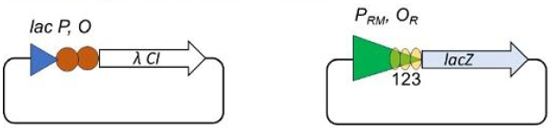
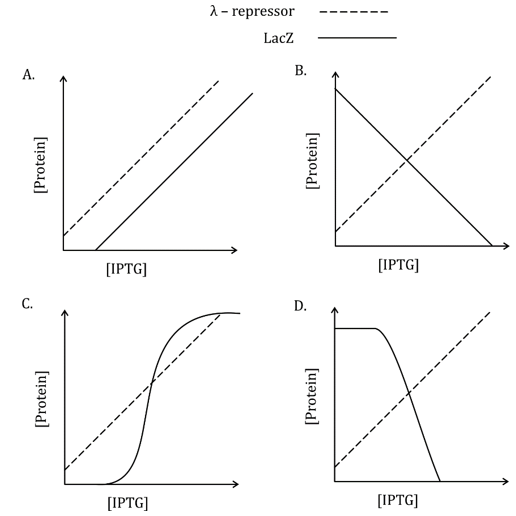
 which one of the following statements about the regulation by CI and Cro proteins is CORRECT?