

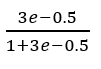


Correct option is A
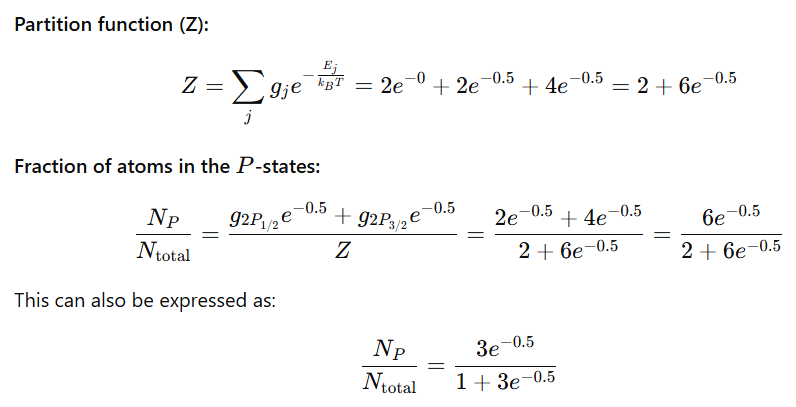
A partition function describes the statistical properties of a system in thermodynamic equilibrium. Partition functions are functions of the thermodynamic state variables, such as the temperature and volume. Most of the aggregate thermodynamic variables of the system, such as the total energy, free energy, entropy, and pressure, can be expressed in terms of the partition function or its derivatives. The partition function is dimensionless.
In systems with multiple quantum states s sharing the same energy Es , it is said that the energy levels of the system are degenerate. Two or more different states of a quantum mechanical system are said to be degenerate if they give the same value of energy upon measurement. In the case of degenerate energy levels, the partition function can be written in terms of the contribution from energy levels (indexed by j) as follows:
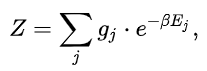
where
· j is the index for the microstates of the system (a microstate is a specific configuration of a system that describes the precise positions and momenta of all the individual particles or components that make up the system);
· e is Euler's number
· β is the thermodynamic beta, defined as 1/kBT where kB is the Boltzmann constant;
· Ej is the total energy of the system in the respective microstate.
· gj (2J+1) is the degeneracy factor, or number of quantum states s that have the same energy level defined by Ej = Es.
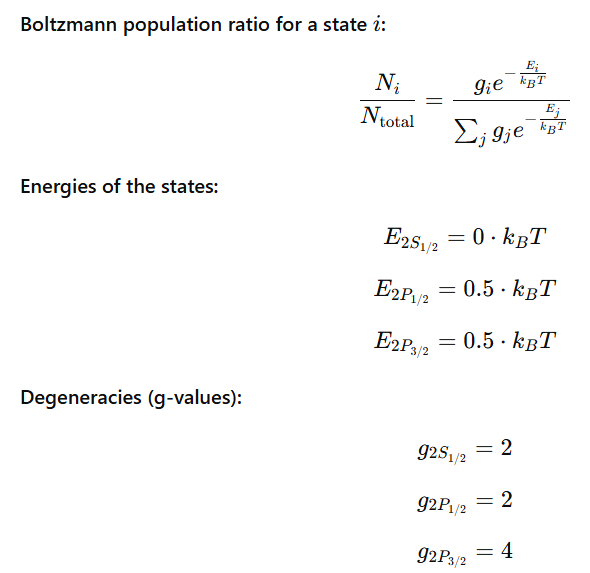
The Boltzmann distribution is often used to describe the distribution of particles, such as atoms or molecules, over bound states accessible to them. If we have a system consisting of many particles, the probability of a particle being in state i is practically the probability that, if we pick a random particle from that system and check what state it is in, we will find it is in state i. This probability is equal to the number of particles in state i divided by the total number of particles in the system, that is the fraction of particles that occupy state i.
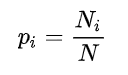
where Ni is the number of particles in state i and N is the total number of particles in the system.