Correct option is D
·
Assertion (A) is false: In
Samanyatodrishta inference, the relation between the major and middle term is based on
observed regularity or correlation, but it does
not depend on causal uniformity. In this type of inference, the relationship is more about consistent observation rather than a cause-effect relationship.
·
Reason (R) is true: The middle term in this type of inference is
not related to the major term as a cause or effect. Instead, the relationship is one of regularity (i.e., consistent co-occurrence), which is observed repeatedly over time.
Information Booster: ·
Samanyatodrishta inference: Refers to
inference based on general observation, where a regular pattern is seen between the major and middle terms, but it does not imply a
causal relationship.
·
Causal uniformity: Is a principle used in other forms of inference, but it is
not the basis of Samanyatodrishta inference, which focuses on empirical regularity.
Additional Knowledge: ·
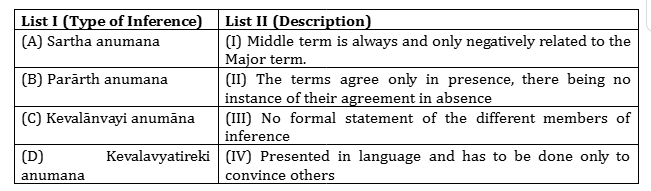
Nyaya logic: Distinguishes between different types of inference, such as
Kevalanvayi (positive correlation) and
Kevalavyatireki (negative correlation), but Samanyatodrishta is about observation without a direct cause-effect relation.
·
Middle term: In an inference, the middle term connects the major and minor terms but in Samanyatodrishta, it does not imply causality, only consistent co-existence.
 English
 10 Questions
 20 Marks
 12 Mins