Correct option is A
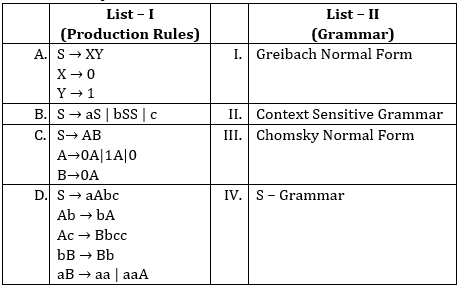
The four classes in the Chomsky hierarchy range from less powerful to more powerful languages:
· Regular Languages are the simplest and can be represented by finite automata.
· Context-Free Languages can be represented by context-free grammars, allowing more flexibility (e.g., recursion).
· Context-Sensitive Languages allow rules that depend on context, providing even more computational power.
· Unrestricted Grammars have no restrictions on their production rules, making them the most powerful.
Information Booster:
1. Regular Languages: Defined by finite automata; limited in expressive power but efficient in computation.
2. Context-Free Languages: Often used for programming languages due to their flexibility in representing recursive structures.
3. Context-Sensitive Languages: Provide more control over context in grammatical rules, useful in describing complex structures.
4. Unrestricted Grammars: The most general class, capable of representing any Turing-complete computation.
Additional Knowledge:
· Context-Free Languages are powerful enough to describe most of the syntax of programming languages.
· Regular Languages are commonly used for lexical analysis, such as tokenizing input in compilers.
· Regular Languages are the simplest and can be represented by finite automata.
· Context-Free Languages can be represented by context-free grammars, allowing more flexibility (e.g., recursion).
· Context-Sensitive Languages allow rules that depend on context, providing even more computational power.
· Unrestricted Grammars have no restrictions on their production rules, making them the most powerful.
Information Booster:
1. Regular Languages: Defined by finite automata; limited in expressive power but efficient in computation.
2. Context-Free Languages: Often used for programming languages due to their flexibility in representing recursive structures.
3. Context-Sensitive Languages: Provide more control over context in grammatical rules, useful in describing complex structures.
4. Unrestricted Grammars: The most general class, capable of representing any Turing-complete computation.
Additional Knowledge:
· Context-Free Languages are powerful enough to describe most of the syntax of programming languages.
· Regular Languages are commonly used for lexical analysis, such as tokenizing input in compilers.
 English
 10 Questions
 20 Marks
 12 Mins