Correct option is D
Explanation:
Apoptosis occurs through two main pathways:
- Extrinsic Pathway (Death Receptor-Mediated)
- Initiated by the binding of death ligands (e.g., Fas ligand) to death receptors (Fas, TNF receptors) on the cell surface.
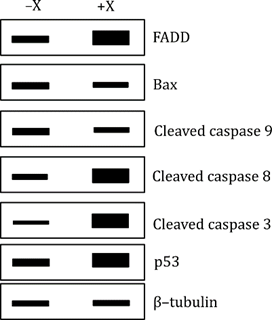
- Leads to the formation of the Death-Inducing Signaling Complex (DISC), which activates caspase-8, triggering downstream caspase activation.
- Intrinsic Pathway (Mitochondrial Pathway)
- Regulated by Bcl2 family proteins (e.g., Bcl2, Bax, Bak).
- Involves mitochondrial outer membrane permeabilization (MOMP), leading to cytochrome c release.
- Cytochrome c binds to Apaf1, forming the apoptosome, which activates caspase-9, further activating executioner caspases (caspase-3, -7).
Evaluation of Statements:
- Statement A (Incorrect)
- This describes the extrinsic pathway, where the Fas ligand binds to Fas receptors and activates DISC (Death-Inducing Signaling Complex).
- The intrinsic pathway is not dependent on Fas-FasL interactions.
- Statement B (Correct)
- The intrinsic pathway is tightly regulated by the Bcl2 family of proteins.
- Statement C (Incorrect)
- Apaf1 is indeed a key regulatory protein in the apoptosome.
- However, it is NOT part of the electron transport chain (ETC); instead, cytochrome c is the ETC component released from mitochondria during apoptosis.
- Statement D (Correct)
- Once cytochrome c binds to Apaf1, it forms the apoptosome, which recruits procaspase-9.
- Activated caspase-9 then cleaves and activates executioner caspases (caspase-3, -7), leading to apoptotic cell death.
Thus, the correct answer is (d) B and D only.
Information Booster:
- Caspases (Cysteine Aspartate Proteases):
- Initiator caspases: Caspase-8 (extrinsic), Caspase-9 (intrinsic)
- Executioner caspases: Caspase-3, Caspase-7
- Bcl2 Family Proteins:
- Pro-apoptotic: Bax, Bak, Bid
- Anti-apoptotic: Bcl2, Bcl-xL
- Apoptosome Formation (Intrinsic Pathway):
- Cytochrome c + Apaf1 + ATP → Apoptosome formation
- Procaspase-9 activation → Caspase-9 activation
- Activation of executioner caspases → Apoptosis
- Extrinsic vs. Intrinsic Apoptosis:
- Extrinsic pathway: Death receptors (Fas, TNF) activate caspase-8 via DISC.
- Intrinsic pathway: Mitochondrial stress leads to cytochrome c release, activating caspase-9.