






Correct option is B
Given:
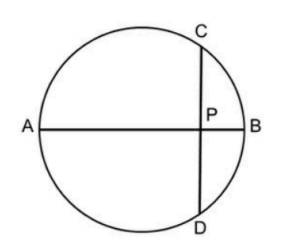
- CP = 2 units
- PB = 1 unit
- AB is the diameter of the circle
- CD is perpendicular to AB and intersects AB at point P
- O is the center of the circle, so AB = 2r and OB = r
Concept:
- Pythagoras' theorem states h2 = p2 + b2 where h is the hypotenuse, p is perpendicular, and b is the base of a right-angled triangle.
- (a + b)(a - b) = a2 - b2.
Solution:
Given CP = 2 and PB = 1
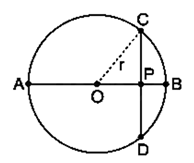
Let the radius of the circle be r.
=> OC = OB = r.
Consider triangle OCP.
CP = 2 (given)
OC = r (radius)
OP = OB - PB.
OP = r - 1
Δ OCP is a right-angled triangle at P.
∴ OC2 = OP2 + CP2 (Pythagoras theorem)
=> r2 = (r - 1)2 + 22.
=> r2 - (r - 1)2 = 4.
=>(r2 -( r2 + 1 - 2r)) = 4.
=>(2r - 1) = 4.
=> 2r = 4 + 1
=> 2r = 5.
=> r = 2.5
The correct answer is option B.


