Correct option is A
Given:
1. Diameter of the tyre = 1 meter.
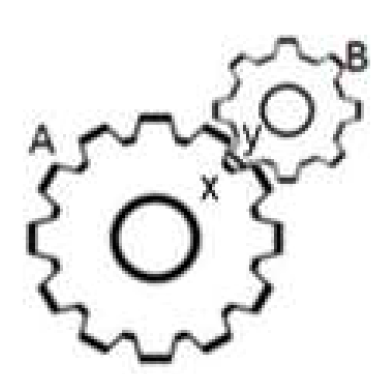
2. Gearwheel A has 12 teeth, and Gearwheel B has 8 teeth.
3. Gearwheel A meshes with Gearwheel B.
4. Points "x" on A and "y" on B are initially in contact.
We need to determine the distance traveled by the vehicle when "x" and "y" are in contact again.
Concept/Formula Used:
1. Teeth Ratio for Contact Alignment: To realign points "x" and "y", both gearwheels need to complete an integer number of revolutions simultaneously. This happens when the number of revolutions corresponds to the least common multiple (LCM) of their teeth.
2. Circumference of the Tyre: The tyre rotates as the vehicle moves forward. The distance traveled by the vehicle equals the circumference of the tyre multiplied by the number of tyre revolutions.
3. Link Between Tyre and Gearwheel A: The tyre's rotation is directly proportional to the rotation of Gearwheel A since they are connected by the same shaft.
4. Distance Traveled = Circumference × Number of Tyre Revolutions.
Solution:
LCM of Teeth Counts: Gearwheel A has 12 teeth, and Gearwheel B has 8 teeth. The least common multiple (LCM) of 12 and 8 is 24. This means Gearwheel A must complete 2 revolutions (24 ÷ 12), and Gearwheel B must complete 3 revolutions (24 ÷ 8) for "x" and "y" to realign.
Circumference of the Tyre: The circumference of the tyre = π × diameter = π × 1 = π meters.
Tyre Revolutions Required: Gearwheel A completes 1 revolution for every tyre revolution. Since Gearwheel A completes 2 revolutions, the tyre also completes 2 revolutions.
Distance Traveled by the Vehicle: Distance traveled = Circumference of the tyre × Number of tyre revolutions. Distance traveled = π × 2 = 2π meters.
Final Answer: The vehicle will travel 2π meters. Correct option: (a) 2π.