arrow
arrow
arrow
A transformer has positive voltage regulation when its load power factor is:
Question

A transformer has positive voltage regulation when its load power factor is:

A.

zero

B.

leading

C.

lagging

D.

unity

Correct option is C

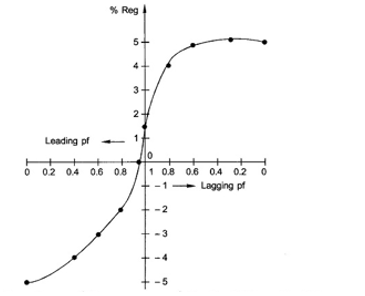
 The positive regulation produces a voltage drop in the winding while a negative regulation produces a voltage rise in the winding. Voltage regulation is the measure of how well a transformer can maintain a constant secondary voltage under varying load conditions, as the output secondary voltage may not be what we expect. Voltage regulation of single-phase transformers is the percentage (or per unit value) change in its secondary terminal voltage compared to its original no-load voltage under varying secondary load conditions. In other words, regulation determines the variation in secondary terminal voltage which occurs inside the transformer as a result of variations in the transformer connected load thereby affecting its performance and efficiency if these losses are high and the secondary voltage becomes too low. A leading power factor (capacitive load), the output terminal voltage will rise. Voltage regulation for the transformer is given by the ratio of change in secondary terminal voltage from no load to full load to no-load secondary voltage.Voltage regulation=(E2V2)E2It can also be expressed as,Regulation=(I2R02cosϕ2±I2X02sinϕ2)E2 + sign is used for lagging loads  sign is used for leading loads\bullet \ \text{The positive regulation produces a voltage drop in the winding while a negative regulation produces a voltage rise in the winding.} \\[6pt]\bullet \ \text{Voltage regulation is the measure of how well a transformer can maintain a constant secondary voltage under varying load conditions, as the output secondary voltage may not be what we expect.} \\[8pt]\bullet \ \text{Voltage regulation of single-phase transformers is the percentage (or per unit value) change in its secondary terminal voltage compared to its original no-load voltage under varying secondary load conditions.} \\[8pt]\bullet \ \text{In other words, regulation determines the variation in secondary terminal voltage which occurs inside the transformer as a result of variations in the transformer connected load thereby affecting its performance and efficiency if these losses are high and the secondary voltage becomes too low.} \\[8pt]\bullet \ \text{A leading power factor (capacitive load), the output terminal voltage will rise.} \\[8pt]\bullet \ \text{Voltage regulation for the transformer is given by the ratio of change in secondary terminal voltage from no load to full load to no-load secondary voltage.} \\[6pt]\text{Voltage regulation} = \frac{(E_2 - V_2)}{E_2} \\[8pt]\text{It can also be expressed as,} \\[4pt]\text{Regulation} = \frac{(I_2 R_{02} \cos \phi_2 \pm I_2 X_{02} \sin \phi_2)}{E_2} \\[10pt]\bullet \ + \text{ sign is used for lagging loads} \\[6pt]\bullet \ - \text{ sign is used for leading loads}​​


test-prime-package

Access ‘UPMRC JE’ Mock Tests with

  • 60000+ Mocks and Previous Year Papers
  • Unlimited Re-Attempts
  • Personalised Report Card
  • 500% Refund on Final Selection
  • Largest Community
students-icon
354k+ students have already unlocked exclusive benefits with Test Prime!
test-prime-package

Access ‘UPMRC JE’ Mock Tests with

  • 60000+ Mocks and Previous Year Papers
  • Unlimited Re-Attempts
  • Personalised Report Card
  • 500% Refund on Final Selection
  • Largest Community
students-icon
354k+ students have already unlocked exclusive benefits with Test Prime!
Our Plans
Monthsup-arrow