Correct option is B
To detect parasite-derived antigens, we need a labeling method that specifically marks parasite proteins while minimizing host cell labeling.
A (32P-ATP labeling) – Incorrect
- 32P-ATP labels nucleotides and phosphorylated molecules.
- While P. falciparum has an active nucleotide metabolism, ATP is utilized by both the host and parasite.
- This does not specifically label parasite-derived proteins.
B (125I- labeling) – Incorrect
- 125I -iodinates tyrosine residues, which primarily labels surface proteins.
- This method is commonly used for membrane proteins but does not distinguish host vs. parasite proteins.
- This is not the best choice for parasite-specific labeling.
C (35S-Methionine labeling) – Correct
- 35S-Methionine incorporates into newly synthesized proteins.
- Since P. falciparum actively synthesizes its own proteins inside infected erythrocytes, this method selectively labels parasite-derived proteins.
- This is the best approach to detect parasite-specific antigens.
- 35S-Methionine incorporates into newly synthesized proteins.
D ( 3H -Hypoxanthine labeling) – Incorrect
- Plasmodium relies on hypoxanthine for purine synthesis since it lacks de novo purine synthesis.
- While this method marks parasite nucleic acids (DNA/RNA), it does not effectively label proteins.
- This is not suitable for immunoprecipitation of proteins.
Thus, 35S-Methionine (Option C) is the most appropriate method for detecting parasite-derived antigens.
Information Booster
- Autoradiography helps detect radiolabeled molecules after separation (e.g., via SDS-PAGE).
- Methionine and cysteine are sulfur-containing amino acids, making 35S-Methionine a strong protein-labeling agent.
- Plasmodium falciparum imports hypoxanthine due to its lack of de novo purine synthesis.
- Iodination with 125I primarily labels membrane proteins and does not specifically target parasite-derived proteins.
- 32P labeling is useful for nucleotides and phosphorylated proteins, but it does not distinguish between host and parasite components.
- Hypoxanthine incorporation is used for measuring parasite growth but is not ideal for protein labeling.
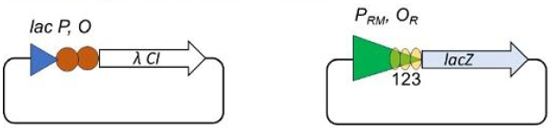
 which one of the following statements about the regulation by CI and Cro proteins is CORRECT?