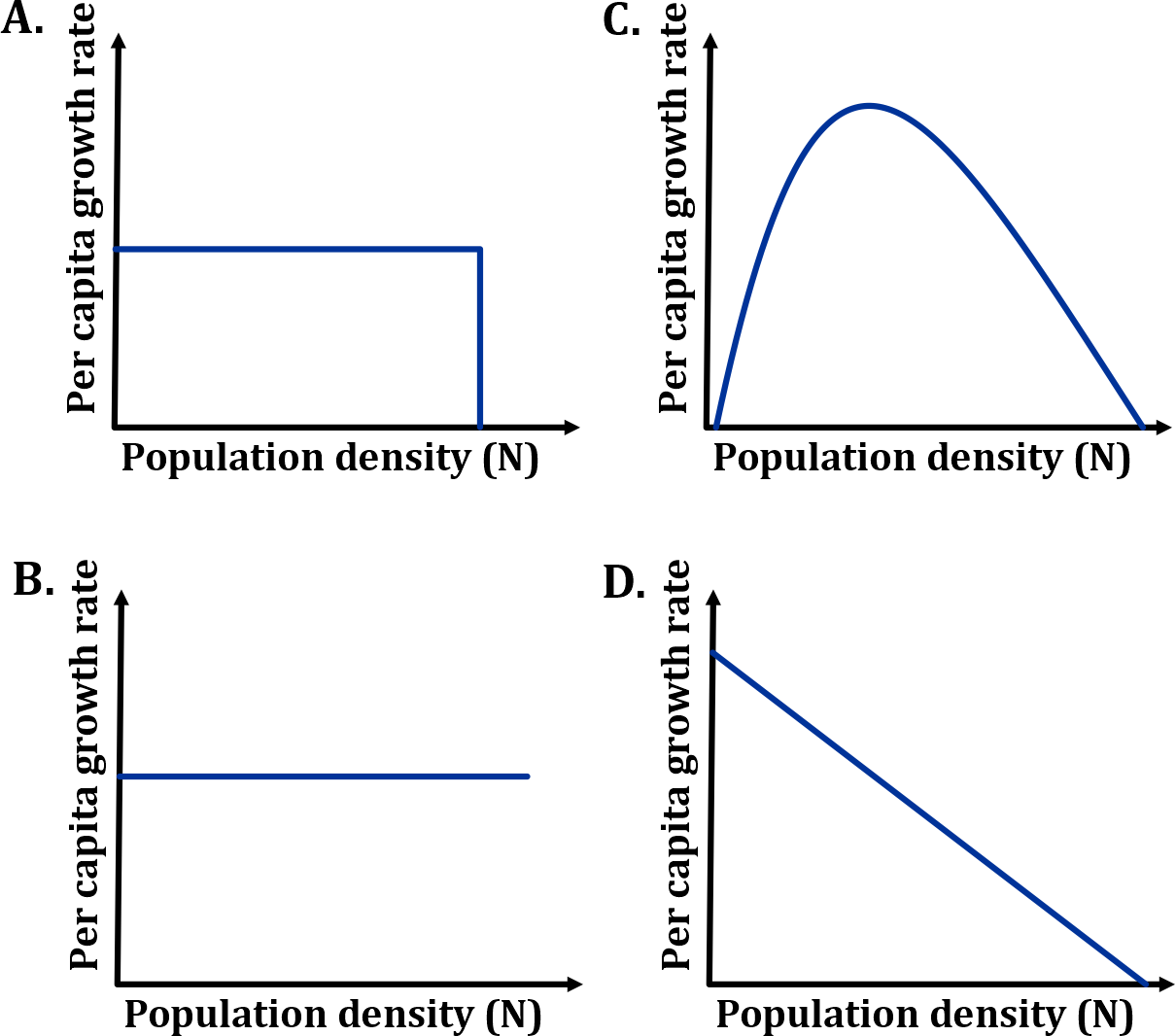
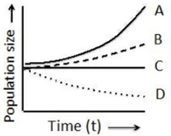
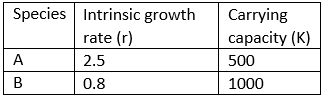
Correct option is A
The Allee effect describes a positive relationship between individual fitness (reproductive success, survival) and population size at small population densities. This means that as population size increases, the average individual fitness also increases—up to a certain point.
Causes of the Allee Effect:
- Difficulty in Finding Mates – Small populations may struggle with reproduction due to fewer potential mates.
- Cooperative Behaviors – Some species rely on group hunting, defense, or social interactions for survival (e.g., wolves, bees).
- Genetic Issues – Small populations face inbreeding depression and reduced genetic diversity.
- Predation & Protection – Larger groups offer better protection from predators.
Information Booster
Types of Allee Effects:
- Strong Allee Effect – Below a critical population size, the population may decline to extinction.
- Weak Allee Effect – A population grows more slowly at low densities but does not necessarily go extinct.
Relation to Conservation Biology – Many endangered species suffer from Allee effects, making population recovery difficult.
Difference from Density Dependence –
- Allee Effect: Positive correlation between fitness and population size.
- Negative Density Dependence: Overcrowding reduces fitness (e.g., resource competition).
Additional Information
Option (2) Founder Effect (Incorrect):
- Describes loss of genetic variation when a new population is established by a small number of individuals.
Option (3) Rensch’s Rule (Incorrect):
- Describes sex-based size differences in animals, where size dimorphism changes with body size.
Option (4) Bergmann’s Rule (Incorrect):
- States that warm-blooded animals in colder climates are larger to conserve heat.