Correct option is C
Explanation:
- The Fe⁺⁺ operon must be regulated based on iron availability in the environment.
- When Fe⁺⁺ is high, bacteria need genes to be expressed to tolerate iron overload.
- The best regulatory mechanism would involve a repressor protein that is inactivated by Fe⁺⁺, allowing transcription to proceed.
- This mechanism is similar to the Lac operon, where the repressor becomes inactive when bound to lactose, permitting gene expression.
Thus, the correct mechanism is:
- In the absence of Fe⁺⁺, the repressor remains active, preventing operon expression.
- In the presence of Fe⁺⁺, the repressor is inactivated, allowing transcription of iron-tolerance genes.
This matches Option (c).
Information Booster:
- Operons in Bacteria:
- Lac operon: Repressor is inactivated by lactose (inducible system).
- Trp operon: Repressor is activated by tryptophan (repressible system).
- Fe⁺⁺ operon (artificial) should work like the Lac operon, allowing genes to function when iron is present.
- Iron Regulation in Bacteria:
- Ferric uptake regulator (Fur): A repressor that binds Fe²⁺ and controls iron uptake.
- In high Fe²⁺ conditions, Fur is inactivated, leading to gene expression.
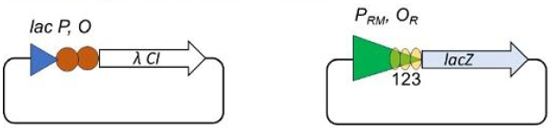
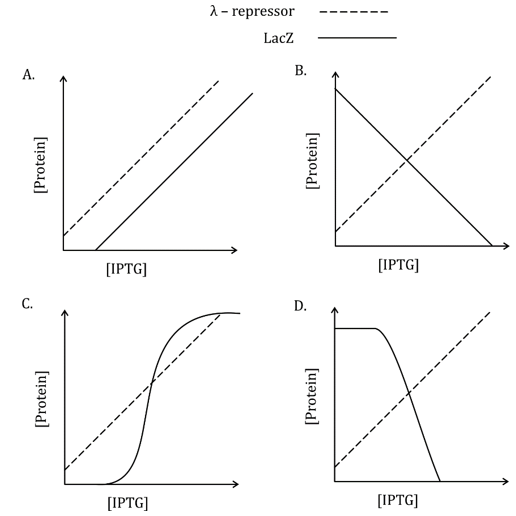
 which one of the following statements about the regulation by CI and Cro proteins is CORRECT?