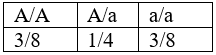
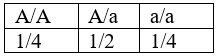
Correct option is B
We are given a founder population with only Aa heterozygous individuals, and self-fertilization is repeated over three generations. We need to determine the genotype frequencies of AA, Aa, and aa after three generations.
Understanding the Genotypic Outcome:
We are starting with a population where all individuals are Aa (heterozygous). The self-fertilization of an Aa x Aa cross (the offspring of two heterozygotes) produces offspring in the following proportions:
1/4 AA (homozygous dominant)
1/2 Aa (heterozygous)
1/4 aa (homozygous recessive)
Step-by-step Breakdown:
Generation 1:
The first generation consists entirely of Aa individuals. When these Aa individuals self-fertilize, the resulting offspring will be:
AA = 1/4 (25%)
Aa = 1/2 (50%)
aa = 1/4 (25%)
Generation 2:
In generation 2, the offspring from generation 1 (which includes AA, Aa, and aa) will also self-fertilize. The genotype frequencies will remain the same because the self-fertilization of Aa x Aa continues to yield the same proportions:
AA = 1/4
Aa = 1/2
aa = 1/4
Generation 3:
By the third generation, the genotype frequencies have stabilized, and they will remain the same as in generation 2. The ratio will still be:
AA = 1/4
Aa = 1/2
aa = 1/4
Conclusion:
After three generations of self-fertilization, the genotype frequencies stabilize to:
AA = 1/4
Aa = 1/2
aa = 1/4
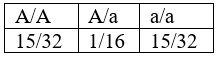
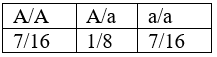
This corresponds to Option 2:
AA = 7/16
Aa = 1/8
aa = 7/16
Therefore, the correct answer is Option 2.