Correct option is D
A (Cells grown in glucose or galactose lead to increased transposon copy number)
- Incorrect:
- The GAL promoter is inducible by galactose but is repressed by glucose in yeast.
- If the transposon integrates into a new location without the GAL promoter, it will no longer be inducible by galactose.
- This means that after the initial transposition, further increases in copy number may not happen.
- Incorrect:
B (Transposed copies will be the same as the construct inserted in the genome)
- Incorrect:
- The original construct includes the GAL promoter.
- However, new transposed copies may not include the GAL promoter, depending on how transposition occurs.
- If the transposed copies do not carry the promoter, they will not behave exactly the same as the original construct.
- Incorrect:
C (Transposed copies cannot transpose further)
- Incorrect:
- If a transposed copy lands in a region with an active promoter, it could still transpose.
- The ability to transpose further depends on whether the regulatory elements (like the GAL promoter) are still functional in the new location.
- Incorrect:
D (Transposed copies will not respond to glucose or galactose in the media)
- Correct:
- Once the retroposon has moved to a new location, it is no longer under the control of the GAL promoter unless it happens to integrate into a site near another GAL-regulated sequence.
- This means that new copies will not respond to glucose or galactose, as their activity will be dependent on the regulatory elements at their new location.
- Correct:
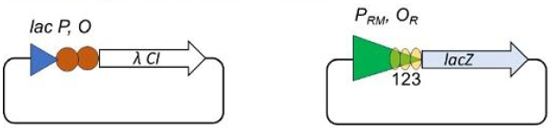
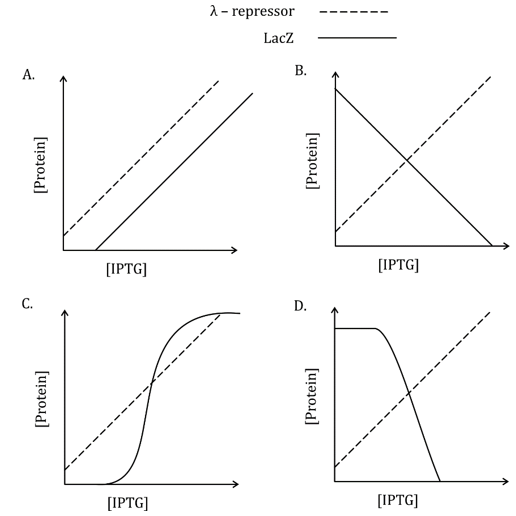
 which one of the following statements about the regulation by CI and Cro proteins is CORRECT?