Correct option is A
Explanation-
Option a — Gastrulation begins with the invagination of bottle cells, followed by coordinated involution of the mesodermal precursors and the epiboly of the prospective ectoderm.
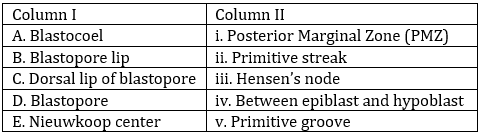
This describes gastrulation in amphibians accurately. Bottle cells at the dorsal lip of the blastopore invaginate first. After the bottle cells invaginate, the mesodermal precursor cells (which will form muscles, notochord, blood, etc.) roll inward at the blastopore. This inward movement is called involution, helping to position these cells correctly. While mesoderm and endoderm cells move inward, the ectodermal cells (future skin and neural tissue) spread outward and over the embryo. This spreading is known as epiboly, covering the surface of the embryo.
Incorrect options-
Option b – "The organizer induces the Nieuwkoop center"
This statement is reversed. Actually, the Nieuwkoop center (located dorsally, formed due to β-catenin localization) induces the formation of the organizer (also known as Spemann’s organizer).
Option c – "The organizer is formed by the accumulation of β-catenin"
This is also correct biologically. β-catenin accumulation in dorsal cells activates genes like siamois that help form the Spemann organizer. However, if only one correct statement must be selected and Option a gives a more detailed and descriptive correct developmental process, it is often considered more accurate in such questions.
Option d – "In the absence of BMP inhibitors, ectodermal cells form neural tube"
BMP signaling promotes epidermal fate, and only inhibition of BMP (by molecules like Noggin, Chordin, Follistatin) leads to neural tissue formation. So in the absence of BMP inhibitors, ectoderm does NOT form the neural tube — it becomes skin/epidermis.
Final Answer: Option a - Gastrulation begins with the invagination of bottle cells, followed by coordinated involution of the mesodermal precursors and the epiboly of the prospective ectoderm.