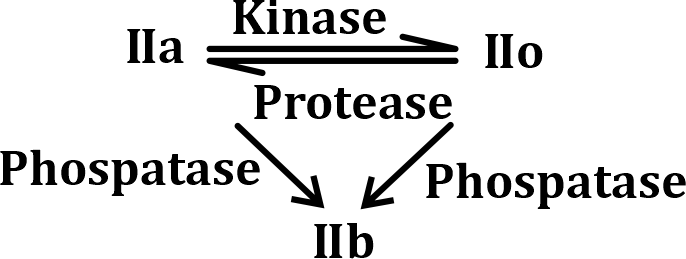
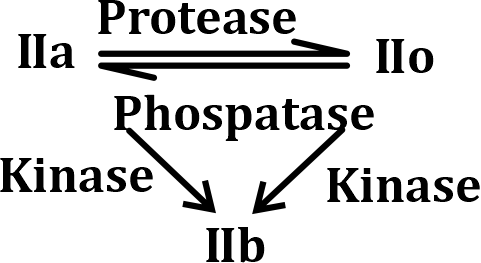
Correct option is A
Explanation-
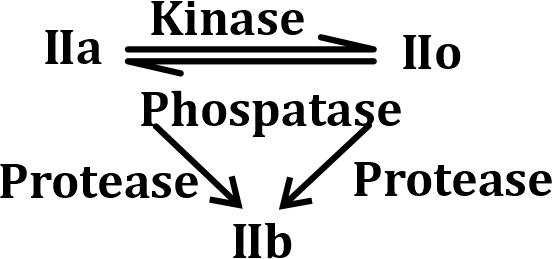
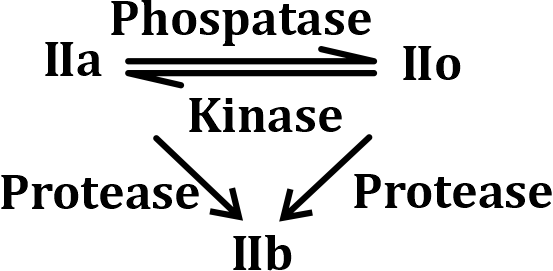
RNA polymerase II (Pol II) is responsible for transcribing most eukaryotic mRNA. Its largest subunit has a C-terminal domain (CTD) made up of heptapeptide repeats (YSPTSPS), which undergo dynamic phosphorylation and dephosphorylation during the transcription cycle. This gives rise to different forms of Pol II:
Forms of RNA Polymerase II:
IIa - Unphosphorylated CTD — ready for transcription initiation
IIo - Hyperphosphorylated CTD — active during transcription elongation
IIb - A processed (cleaved) or inactive form, typically lacking part of the CTD
Enzymes Involved in Interconversion
Kinase - Adds phosphate groups to CTD — converts IIa → IIo
Phosphatase - Removes phosphate groups — converts IIo → IIa
Protease - Cuts/cleaves the CTD — converts IIa or IIo → IIb
Transformation Pathways
Step 1: IIa → IIo
Kinase adds phosphate groups to serine residues in the CTD heptapeptide repeats. It happens when RNA Pol II transitions from initiation to elongation.
Step 2: IIo → IIa
Phosphatase removes phosphate groups, returning CTD to an unphosphorylated state. This is needed to reset Pol II after a transcription cycle for another round of initiation.
Step 3: IIa or IIo → IIb
Protease cleaves part of the CTD tail, leading to a form that is nonfunctional or irreversibly inactive. This is often a degradation or irreversible modification step.
Final answer - Option a
Option a is the only one that correctly reflects all three transitions, making it the correct and biologically accurate schematic for RNA polymerase II subunit relationships.