






Correct option is B
Explanation:
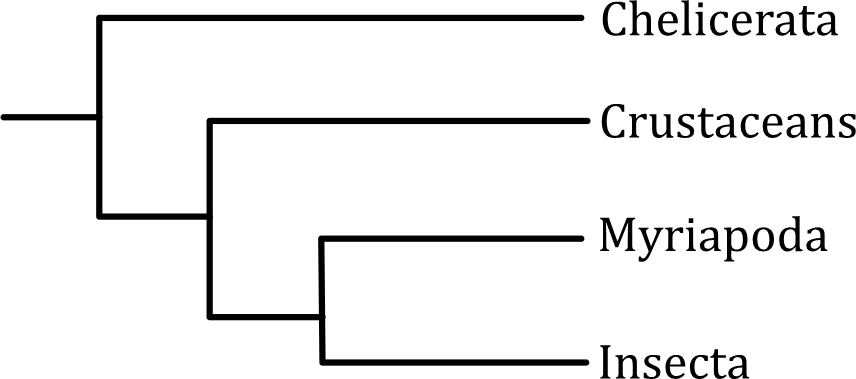
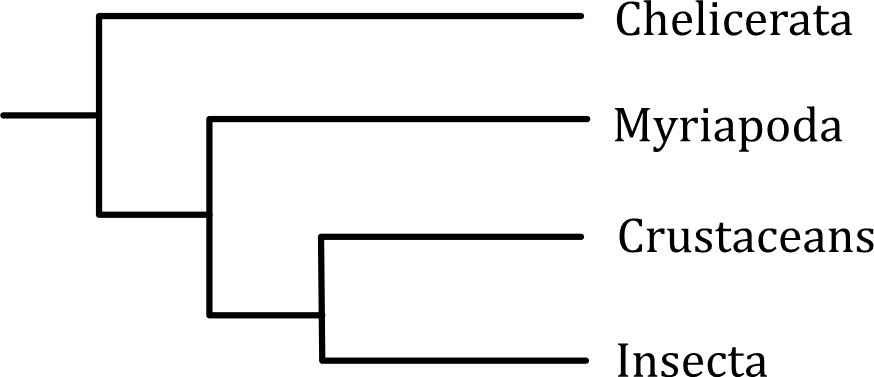
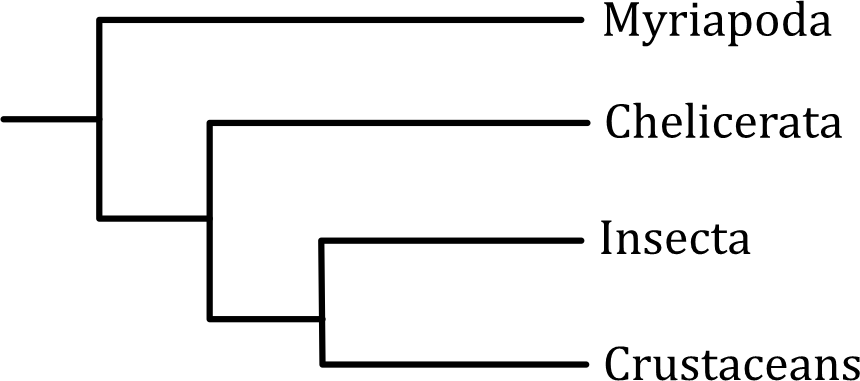
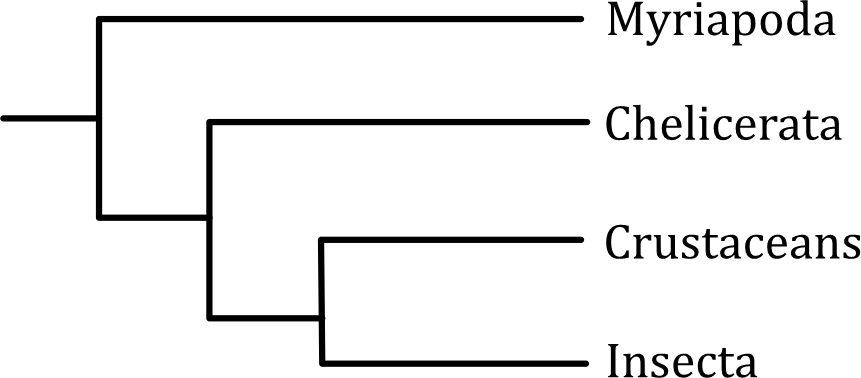
- Option (2) correctly reflects the molecular phylogeny that supports Chelicerata and Myriapoda as more closely related to each other, while Crustaceans and Insects are more distantly related to both groups.
- Recent molecular studies confirm that Chelicerata and Myriapoda (centipedes, millipedes, etc.) share a common evolutionary ancestor. This relationship is sometimes grouped under the term Myriochelata.
- The Crustaceans (crabs, lobsters, shrimp) and Insects (beetles, ants, butterflies, etc.) are closer to each other than to Myriapoda and Chelicerata, and they are part of a clade known as Pancrustacea.
Information Booster:
- Myriapoda and Chelicerata share a closer evolutionary relationship, forming a monophyletic group.
- Crustaceans are considered to be more distantly related to Myriapoda and Chelicerata within the arthropod clade.
- Insects are often grouped with Crustaceans under the Pancrustacea hypothesis, suggesting that insects and crustaceans share a more recent common ancestor than either does with Myriapoda or Chelicerata.
- Molecular phylogenetics uses DNA and protein sequences to infer the evolutionary relationships among different groups, providing insights into the actual evolutionary history rather than morphological traits alone.
- The use of molecular data has reshaped our understanding of the relationships between arthropod groups, with some traditional classifications being revised based on genetic evidence.


