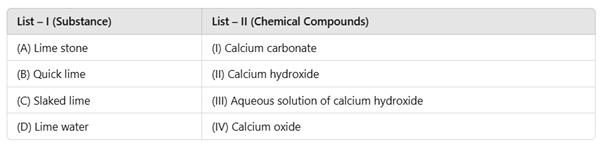
Correct option is B
Metalloids are elements that have properties intermediate between metals and nonmetals. These elements are typically found along the "stair-step" line in the periodic table, separating metals and nonmetals.
1. Silicon (Si):
· Silicon is classified as a metalloid due to its ability to act as a semiconductor, combining metallic and nonmetallic properties.
· It is located along the metalloid line in the periodic table and is widely used in electronic devices.
2. Other Options:
· Aluminium (a): A metal, not a metalloid, as it lacks the intermediate properties.
· Beryllium (c): A metal found in Group 2 (alkaline earth metals).
· Phosphorus (d): A nonmetal, not a metalloid, due to its nonmetallic properties.
Thus, Silicon is the correct answer as it exhibits typical metalloid characteristics.
Information Booster: 1. Common Metalloids:
· Boron (B)
· Silicon (Si)
· Germanium (Ge)
· Arsenic (As)
· Antimony (Sb)
· Tellurium (Te)
· Polonium (Po)
2. Properties of Metalloids:
· Exhibit a mix of metallic and nonmetallic properties.
· Can conduct electricity under specific conditions (semiconductors).
· Have intermediate density and melting points.
3. Applications of Silicon:
· Widely used in the electronics industry for making semiconductors.
· Forms the basis of microchips and solar panels.
4. Position in Periodic Table:
· Metalloids are found along the zigzag line between Groups 13–17.
Additional Knowledge: · Option (a) Aluminium:
· Aluminium is a metal used in various industries for its lightweight and corrosion resistance.
· Option (b) Silicon:
· A well-known metalloid, used in glass, ceramics, and electronics.
· Option (c) Beryllium:
· A rare metal with high strength and low density, used in aerospace applications.
· Option (d) Phosphorus:
· A nonmetal essential for life, used in fertilizers and detergents.
 English
 10 Questions
 20 Marks
 12 Mins