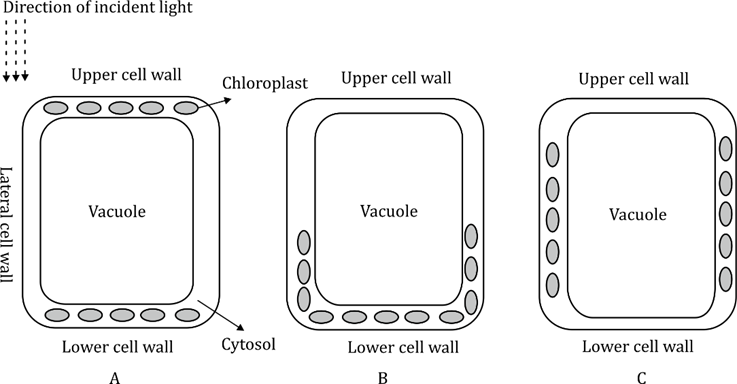
Correct option is A
C4 photosynthesis is a specialized pathway that helps plants efficiently fix CO₂ under high light intensity and water stress conditions. It involves the Hatch-Slack Pathway, where CO₂ is initially fixed into a four-carbon compound before being transported to bundle sheath cells for the Calvin cycle.
Steps of C4 Photosynthesis:
Carbon Fixation in Mesophyll Cells:
- CO₂ is fixed by Phosphoenolpyruvate (PEP) to form Oxaloacetate (OAA) (a four-carbon compound) via the enzyme PEP carboxylase.
- OAA is then converted into Malate or Aspartate, depending on the plant type.
Transport to Bundle Sheath Cells:
- Malate or Aspartate is transported to the bundle sheath cells, where CO₂ is released for the Calvin cycle.
Regeneration of PEP:
- The remaining three-carbon compound (Pyruvate or Alanine) is transported back to mesophyll cells and converted to PEP, allowing the cycle to continue.
Information Booster
- C4 Pathway Overview: A carbon-concentrating mechanism that enhances CO₂ availability for Rubisco, reducing photorespiration.
- C4 Intermediates: The major four-carbon intermediates include Oxaloacetate, Malate, and Aspartate.
- Enzymes Involved:
- PEP Carboxylase → Fixes CO₂ into Oxaloacetate.
- Malate Dehydrogenase → Converts Oxaloacetate into Malate.
- Aspartate Aminotransferase → Converts Oxaloacetate into Aspartate.
- Types of C4 Plants:
- NADP-ME Type: Uses Malate as the CO₂ carrier (e.g., Maize, Sugarcane).
- PCK Type: Uses Aspartate as the CO₂ carrier (e.g., Panicum spp.).
- Efficiency of C4 Photosynthesis:
- Higher water-use efficiency than C3 plants.
- Found in tropical and arid environments.
- Comparison with CAM Plants:
- Both use PEP carboxylation, but CAM plants store CO₂ at night to avoid water loss.
- C4 Evolution:
- Evolved in grasses and some dicots to overcome photorespiration under low CO₂ and high oxygen conditions.