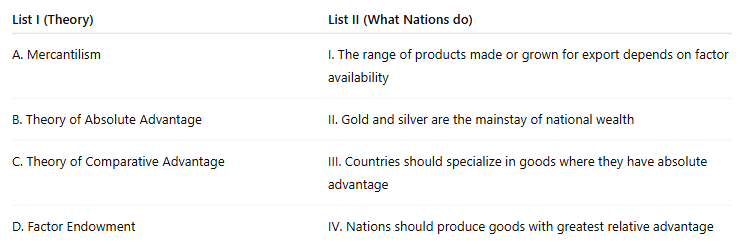
Correct option is C
The correct answer is (c) USA's exports were labour-intensive and imports were capital intensive. This statement summarizes the central finding of the Leontief Paradox, discovered by Wassily Leontief in 1953. According to the Heckscher-Ohlin (H-O) theory, a country like the USA, being capital-abundant, should export capital-intensive goods and import labour-intensive goods. However, Leontief’s empirical analysis showed the opposite:
U.S. exports were more labour-intensive, and
U.S. imports were more capital-intensive.
This finding contradicted the H-O theory’s prediction and came to be known as the Leontief Paradox. It sparked debates in international trade theory and led to the development of alternative models that incorporated differences in technology, human capital, and consumer preferences.
Information Booster:
The Leontief Paradox highlighted a critical inconsistency between theoretical predictions and empirical trade data. Though the U.S. was considered a capital-rich country, it exported labour-intensive goods. This paradox challenged the validity of the Heckscher-Ohlin model, which was based on factor endowments. Several explanations were proposed for this anomaly:
U.S. labour had higher productivity due to better education and skills (i.e., human capital).
U.S. imports may have included natural resource-intensive goods, which the H-O model didn’t fully address.
Differences in technology and product differentiation were not considered in the basic H-O framework.
This paradox is a turning point in international trade theory and has influenced the development of more nuanced models like the Linder hypothesis, new trade theory, and technology-based trade models.
Additional Knowledge:
(a) USA's exports were capital intensive and imports were labour intensive
Incorrect: This is what the Heckscher-Ohlin theory predicted, not what Leontief found. If this were true, there would be no paradox.
(b) USA's exports and imports both were capital intensive
Incorrect: This does not describe Leontief’s findings, which highlighted opposite intensities in exports and imports, not both being capital-intensive.
(d) USA's exports and imports both were labour-intensive
Incorrect: This is not consistent with the data Leontief analyzed. Imports were found to be capital-intensive, not labour-intensive.
 English
 10 Questions
 20 Marks
 12 Mins