Correct option is B
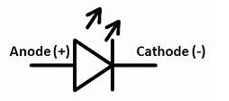
Light Emitting Diode:
It is a heavily doped p-n junction that under forward bias emits spontaneous radiation.
The diode is encapsulated with a transparent cover so that emitted light can come out.
When the diode is forward biased, electrons are sent from n to p (where they are minority carriers) and holes are sent from p to n.
At the junction boundary, the concentration of minority carriers increases compared to the equilibrium concentration (i.e., when there is no bias).
Thus, at the junction boundary on either side of the junction, excess minority carriers are there which recombine with majority carriers near the junction.
On recombination, the energy is released in the form of photons. Photons with energy equal to or slightly less than the band gap are emitted.
When the forward current of the diode is small, the intensity of light emitted is small.
As the forward current increases, the intensity of light increases and reaches a maximum.
Further, an increase in the forward current results in a decrease of light intensity.
LEDs are biased such that the light-emitting efficiency is maximum.
The V - I characteristics of a LED is similar to that of a-Si junction diode.
But the threshold voltages are much higher and slightly different for each colour.
The reverse breakdown voltages of LEDs are very low, typically around 5 V.
So, care should be taken that high reverse voltages do not appear across them.
LED's can emit red, yellow, orange, green, and blue light that are commercially available.
The semiconductor used for fabrication of visible LEDs must at least have a band gap of 1.8eV
Spectral range of visible light is from about 0.4μm to 0.7μm, i.e., from about 3eV to 1.8eV.
They have low power consumption; A seven-segment display requires about 140μW (20 μW/ segment).
This is a great advantage over LEDs which require about 40mW per numeral.
They have a low cost.