






Correct option is A
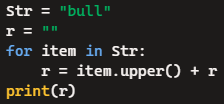
Let’s analyze the code:
· The for loop iterates through each character in the string Str.
· item.upper() converts the current character to uppercase.
· Each uppercase character is added
before the existing value of r.
· This effectively reverses the string while converting it to uppercase.
Step-by-step Execution:
1. Initial r = ""
2. First Iteration (item = 'b'): r = "B" + "" → r = "B"
3. Second Iteration (item = 'u'): r = "U" + "B" → r = "UB"
4. Third Iteration (item = 'l'): r = "L" + "UB" → r = "LUB"
5. Fourth Iteration (item = 'l'): r = "L" + "LUB" → r = "LLUB"
Final Output:
LLUB
Important Key Points:
1. Strings in Python are immutable, but concatenation creates new string objects.
2. The upper() method converts characters to uppercase.
3. Adding characters before the existing string reverses the order.
Knowledge Booster:
·
lower(): Converts a string to lowercase.
·
reversed(): Reverses a sequence but requires explicit joining for strings.
·
join(): Combines elements of an iterable into a single string.
 English
 100 Questions
 100 Marks
 60 Mins


