






Correct option is A
Figure shows the connection diagram for the open circuit test. The high voltage (hv) side is left open.
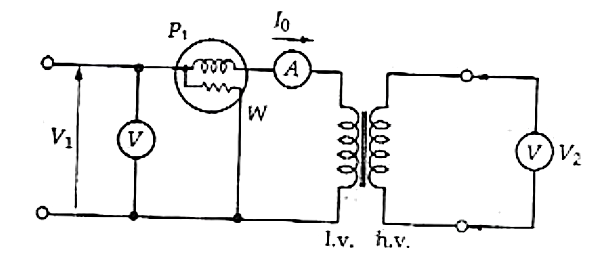
· A voltmeter V, an ammeter A, and a wattmeter W are connected in the low-voltage (lv) side (primary in our case) which is supplied at rated voltage and frequency.
· Thus, the voltmeter V reads the rated voltage V1 of the primary. Since the secondary is open-circuited, a very small current I0 called the no-load current, flows in the primary. The ammeter A, therefore, reads the no-load current I0.
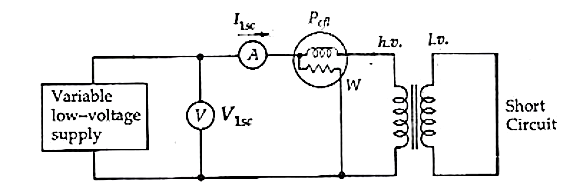
· In the short circuit (SC) test, usually the low-voltage side is short-circuited by a thick conductor (or through an ammeter which may serve an additional purpose of indicating rated load current).
· An ammeter, a voltmeter and a wattmeter are connected on the high-voltage side.
The reasons for short-circuiting the lv side and taking measurements on the hv side are as follow:
· The rated current on hv side is lower than that on lv side This current can be safely measured with the available laboratory ammeters.
· Since the applied voltage is less than 5 percent of the rated voltage of the winding, greater accuracy in the reading of the voltmeter is possible when the hv side is used as the primary.


