
Correct option is A
Leading questions may generally be asked during cross-examination under the Indian Evidence Act, 1872. These questions suggest the answer or assume facts that the witness is expected to confirm, and they are typically used to test the accuracy, credibility, and consistency of the witness's testimony.
Information Booster:
Leading questions are questions that suggest a particular answer or assume a fact that the person asking the question expects the witness to confirm. These are typically phrased in a way that prompts the witness to agree with the implied answer.
Relevant Section:
·
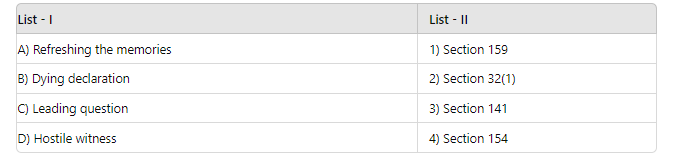
Section 141 of the
Indian Evidence Act, 1872 defines leading questions as questions that suggest the answer which the person putting it wishes or expects to receive.
·
Section 142 specifies that leading questions cannot be asked during
examination-in-chief or
re-examination, unless the court allows them under special circumstances.
·
Section 143 allows leading questions to be asked during
cross-examination.
Key Points:
1.
Cross-examination (Option a): In
cross-examination, leading questions are generally allowed to test the veracity of the witness's statements or to extract specific information from the witness. This process helps challenge the credibility of the testimony provided during the examination-in-chief.
2.
Examination-in-chief (Option b): Leading questions are not allowed during the
examination-in-chief, where the purpose is to allow the witness to give their account of events in their own words. Exceptions exist where the court permits leading questions in cases of introductory or undisputed matters, but this is rare.
3.
Re-examination (Option c): Leading questions are also generally not allowed during
re-examination. The goal of re-examination is to clarify issues raised during cross-examination, and leading the witness in this context is usually not permitted, unless allowed by the court.
4.
None of the above (Option d): This option is incorrect because leading questions are permitted during cross-examination, making
Option (a) the correct answer.
 Code :


