






Correct option is A
Explanation:
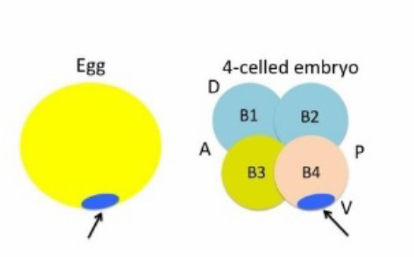
The question involves the experimental support for the hypothesis that the B4 blastomere in the 4-celled embryo develops into the notochord by acquiring and retaining Brainy (a protein identified in the embryo). Let's analyze each statement to see which supports this hypothesis:
A. Microinjection of brainy mRNA in other blastomeres would lead to ectopic development of notochord.
This experiment supports the hypothesis because Brainy is associated with the development of the notochord. Microinjection of brainy mRNA into other blastomeres would likely result in the ectopic development of the notochord, suggesting that Brainy is necessary for the formation of the notochord and supports the role of B4 in notochord development.
This is correct and directly supports the hypothesis.
B. If the 4 blastomeres were dissociated and allowed to develop individually, the B4 blastomere would cease to develop.
This statement is more about the autonomy of the B4 blastomere. However, it doesn't directly support the idea that the B4 blastomere is responsible for notochord development. The B4 blastomere ceasing to develop does not directly provide evidence for the hypothesis related to notochord formation.
This does not directly support the hypothesis.
C. Treating the 4-celled embryo with lithium chloride would lead to the ventralization of the embryo.
Lithium chloride is known to affect embryonic patterning. This treatment would likely affect the development of different parts of the embryo, including the notochord. However, this statement doesn’t directly test the specific role of B4 in notochord development.
This is not directly linked to the hypothesis.
D. Microinjection of morpholinos against brainy mRNA in B3 would convert the fate of B3 to that of B4.
Morpholino treatment to block brainy mRNA would prevent the B3 blastomere from developing into the same fate as B4. This statement suggests that Brainy is necessary for the development of B4, but it does not directly show that B4 is responsible for notochord formation.
This could be seen as related, but it’s not directly confirming the hypothesis about B4's role in notochord development.


