






Correct option is B
The NF-κB signaling pathway is controlled by a negative feedback loop via IκBα. This feedback causes oscillatory behavior under continuous TNF exposure.
Case 1: TNF Pulse Exposure (a)
- Short exposure to TNF briefly degrades IκBα, allowing NF-κB activation for a limited time.
- Once TNF is removed, newly synthesized IκBα restores inhibition, leading to a single peak of NF-κB activation.
- Expected Graph Pattern: A single transient peak of NF-κB activity that returns to baseline.
Case 2: Continuous TNF Exposure (b)
- Persistent TNF stimulation continuously degrades IκBα, leading to prolonged NF-κB activation.
- However, due to negative feedback, IκBα is resynthesized periodically, causing NF-κB levels to oscillate instead of staying continuously high.
- Expected Graph Pattern:Oscillations in NF-κB activation due to periodic inhibition and reactivation.
Analysis of Graph Options:
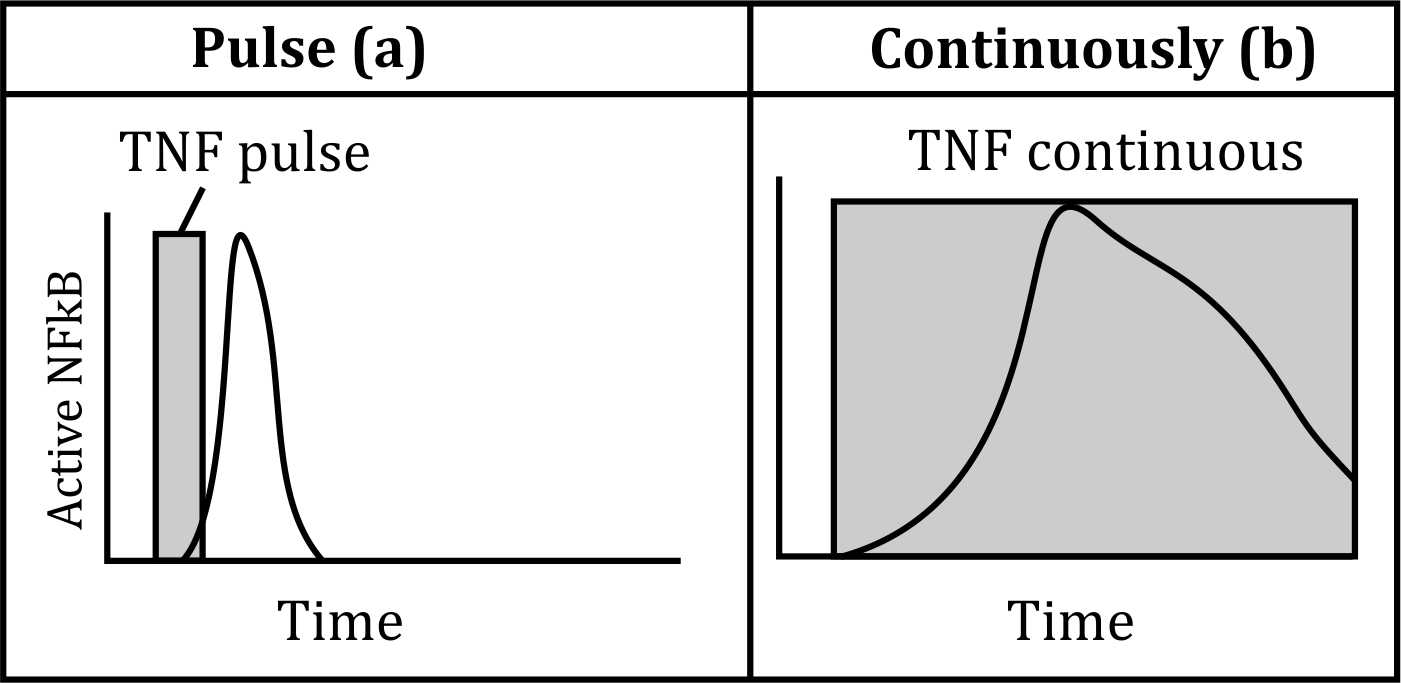
Option 1:
- TNF Pulse: Shows a single peak, which is correct
- TNF Continuous: Shows a gradual increase without oscillations, which is incorrect
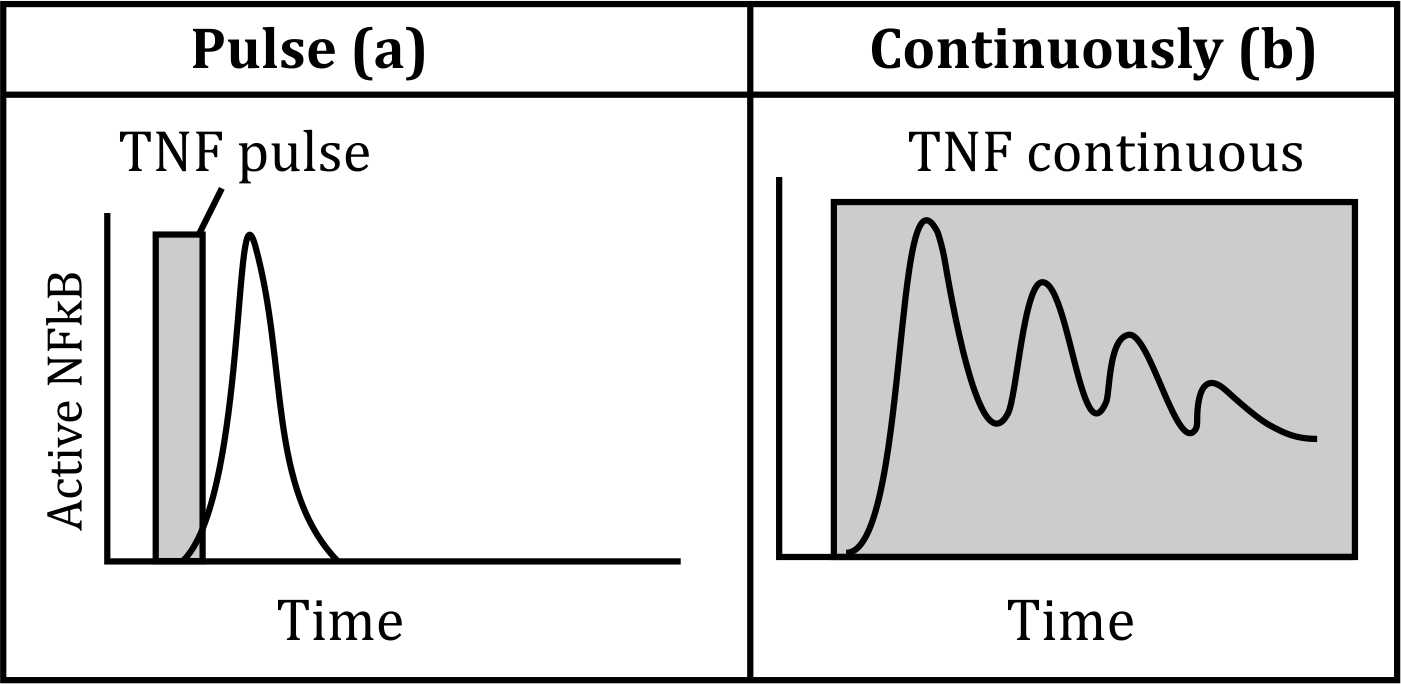
Option 2: Correct
- TNF Pulse: Shows a single peak, which is correct
- TNF Continuous: Shows oscillatory NF-κB behavior, which is expected .
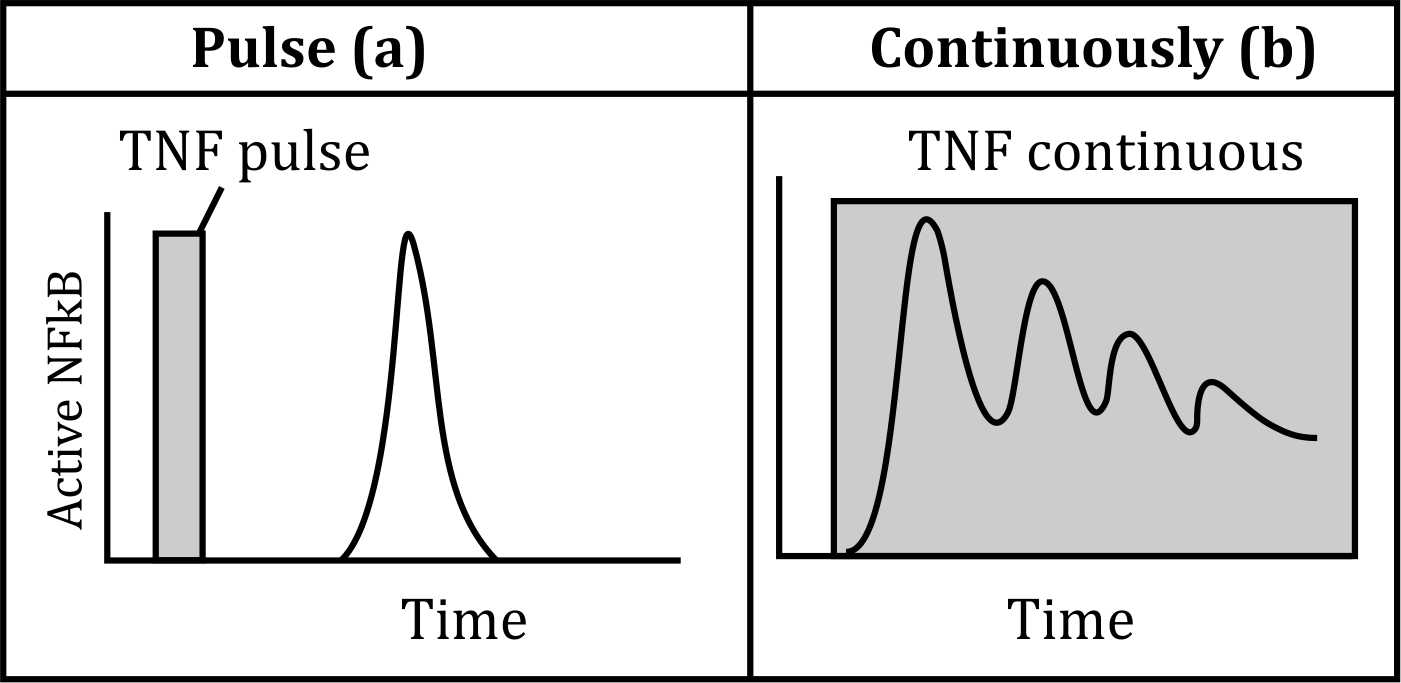
Option 3:
- TNF Pulse: Shows a single peak, which is correct.
- TNF Continuous: Shows oscillations (Correct), but option 2 better matches experimental observations.
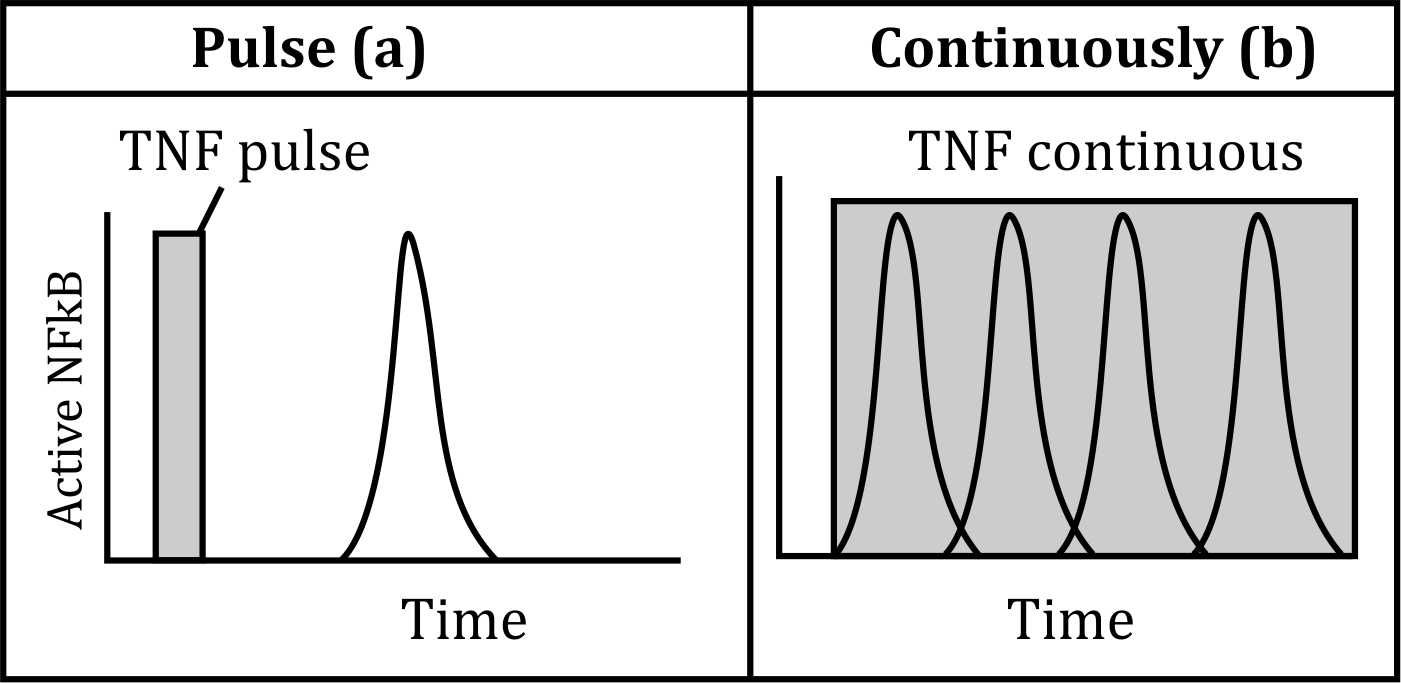
Option 4:
- TNF Pulse: Shows multiple peaks, which is incorrect
- TNF Continuous: Shows oscillations, which is correct , but the pulse response is incorrect.
Information Booster:
NF-κB Show Oscillations in Continuous TNF Exposure
- The negative feedback loop delays IκBα resynthesis, leading to periodic inhibition and reactivation of NF-κB.
- This creates a series of activation-deactivation cycles rather than sustained activation.
There a Single Peak for TNF Pulse
- A short TNF pulse leads to temporary IκBα degradation followed by its resynthesis.
- Since TNF is not continuously present, NF-κB activation does not oscillate.
3. Biological Relevance of NF-κB Oscillations:
- Different oscillation frequencies regulate specific gene expression programs in inflammation and immune responses.
- Sustained activation vs. pulsed activation leads to distinct cellular outcomes.


