

arrow
arrow
arrow
​The following statements have been made regarding cell specification in an early embryo:A. The entire embryo rarely interacts with its environment, a
Question

The following statements have been made regarding cell specification in an early embryo:

A. The entire embryo rarely interacts with its environment, and its developmental trajectory cannot be guided by its immediate “ecosystem”.
B. When cells are removed, changes in cellular biochemistry and function are never preceded by a process involving the commitment of the cell to a certain fate.
C. The fate of a cell or a tissue in the intact embryo is said to be specified when it is not capable of differentiating autonomously on being placed in a neutral environment, such as a petri dish or test tube.
D. If cells are removed, the interactions of the remaining cells compensate the fate of the removed cells, because the fate of a cell depends upon the conditions in which the cell finds itself.

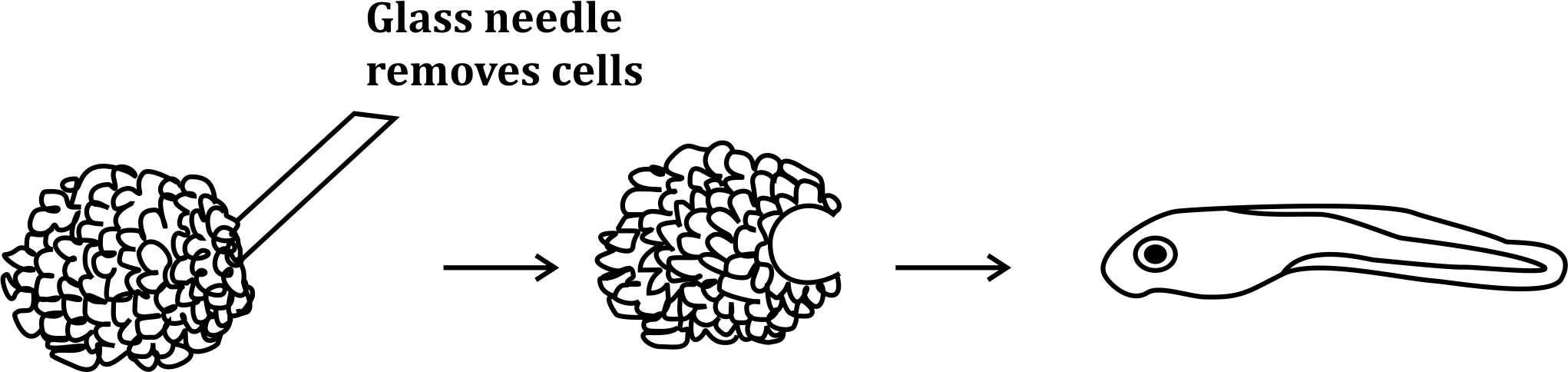
With regard to the experiment shown below, where removal of cells from an early blastula leads to normal development of the larval form, which one of the above combinations of statements apply to the development of the organism?


A.

A and D

B.

Only D

C.

B and C

D.

Only C

Correct option is B

Explanation:

  • Statement A is incorrect because it suggests that the embryo does not interact with its environment, but developmental biology shows that the embryo does interact with its surroundings, influencing its development. Embryos, especially at early stages, are highly sensitive to environmental cues.
  • Statement B is incorrect because it suggests that when cells are removed, the remaining cells do not show any commitment to a fate. In fact, cells in an embryo often communicate with each other, and the removal of cells can influence the fate of the remaining cells (compensatory processes).
  • Statement C is partially correct in describing the specification of a cell’s fate in the intact embryo, but this does not fully explain the compensation mechanism in the experiment described.
  • Statement D is correct in this context because it refers to the compensatory interaction between remaining cells when cells are removed. In the experiment, the removal of cells from an early blastula still allows for normal development, which suggests that the fate of the remaining cells can compensate for the removed cells and lead to normal development.

Information Booster:

  • In early embryonic development, cells often communicate with one another and influence each other’s fate through signals, a process called cell-cell signaling.
  • Compensatory development refers to the ability of the remaining cells to make up for the function of removed cells, which is a key observation in many developmental biology experiments.
  • Fate specification often occurs when cells are unable to differentiate on their own without external cues, but their fate can still be influenced by the environment in which they reside.

Similar Questions

test-prime-package

Access ‘CSIR NET Life Sciences’ Mock Tests with

  • 60000+ Mocks and Previous Year Papers
  • Unlimited Re-Attempts
  • Personalised Report Card
  • 500% Refund on Final Selection
  • Largest Community
students-icon
353k+ students have already unlocked exclusive benefits with Test Prime!
test-prime-package

Access ‘CSIR NET Life Sciences’ Mock Tests with

  • 60000+ Mocks and Previous Year Papers
  • Unlimited Re-Attempts
  • Personalised Report Card
  • 500% Refund on Final Selection
  • Largest Community
students-icon
353k+ students have already unlocked exclusive benefits with Test Prime!
Our Plans
Monthsup-arrow
