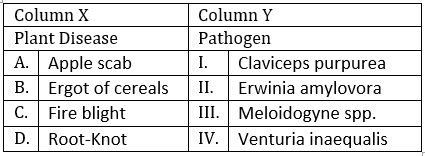
Correct option is B
EXPLANATION-
Statement A - Chemical signals released by the plant roots can induce hatching of the juvenile nematodes.
Root exudates (like root-knot attractants) can stimulate the hatching of second-stage juveniles (J2s) from nematode eggs. This is well-established for root-knot nematodes.
This statement is correct.
Statement B - Mitosis coupled with cytokinesis and DNA endoreduplication is induced during root-knot nematode infection.
In Meloidogyne infection, the giant cells induced in roots undergo mitosis without cytokinesis, leading to multinucleated cells. While endoreduplication (replication of DNA without cell division) occurs, cytokinesis is suppressed, not coupled.
This statement is incorrect.
Statement C - Nematodes form syncytial feeding structures by recruiting plant cells.
This seems confusing because traditionally, syncytia are associated with cyst nematodes (Heterodera spp.). But in a broader usage, the giant cells formed by Meloidogyne can function as a type of syncytium—they are multinucleate and form by fusion or failure of cytokinesis.
This statement is correct.
Statement D - Nematode infections suppress cortical cell growth in plants.
Root-knot nematodes do not directly suppress cortical cell growth. Instead, they stimulate hypertrophy and hyperplasia of root tissues. The cortex may be displaced, but growth is often stimulated, not suppressed, to support gall formation.
This statement is incorrect.
So, the correct option: (b) -A and C