






Correct option is D
The Notch signaling pathway plays a critical role in cell fate determination, where different ligands (Dll1 and Dll4) trigger distinct downstream signaling dynamics.
Key Observations from the Figure:
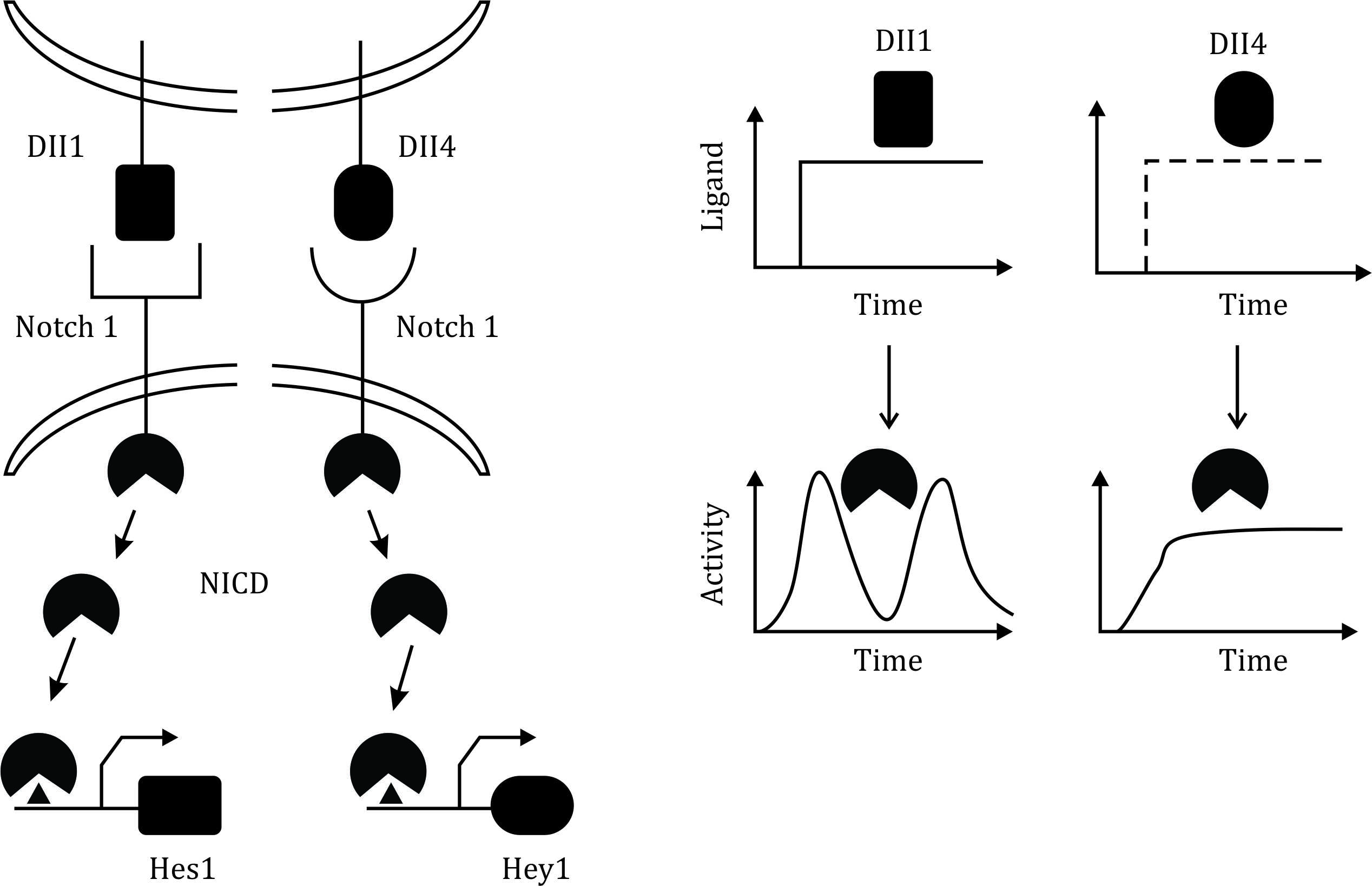
- Dll1 and Dll4 both bind to the Notch1 receptor, leading to the production of the Notch intracellular domain (NICD).
- However, Dll1 leads to a sustained NICD activation pattern, while Dll4 induces pulsatile (oscillatory) NICD activity.
- These different NICD activation dynamics control the expression of distinct target genes:
- Dll1 → Sustained NICD → Hes1 activation
- Dll4 → Pulsatile NICD → Hey1 activation
Thus, the key distinction is not just which genes are activated, but how NICD activity is regulated differently by these two ligands.
Analysis of Answer Choices:
Option 1 (Incorrect ):
- While it correctly states that Dll1 and Dll4 bind Notch1 and activate different effectors, it incorrectly claims that the dynamics are similar.
- The figure clearly shows that Dll1 leads to sustained activation, while Dll4 leads to oscillatory activation, meaning the dynamics are not similar.
Option 2 (Incorrect ):
- While Dll1 does induce a sustained NICD response, this option fails to emphasize that Dll4 induces oscillatory NICD activation.
- The explanation is incomplete, making it incorrect.
Option 3 (Incorrect ):
- While Dll4 does induce pulsatile NICD responses, the explanation is too narrow and does not explain the full context of how both ligands regulate NICD differently.
- The broader question is about how NICD activity differs based on ligand type.
Option 4 (Correct ):
- Both Dll1 and Dll4 bind to Notch1, but their primary difference lies in how NICD is activated dynamically.
- Dll1 induces sustained NICD activation, while Dll4 induces pulsatile NICD activation.
- This matches the observed gene expression differences (Hes1 vs. Hey1 activation), making this the correct interpretation of the data.


