






Correct option is B
Ans. (b)
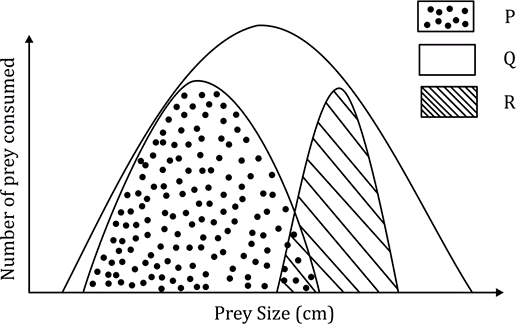
Sol. In the given graph, we can clearly observe that species Q has a larger range of prey sizes in the fundamental niche (the dotted region). However, when competition with species P occurs, the realised niche of species Q is limited to a smaller area (the shaded area corresponding to species Q). The fundamental niche of species P, on the other hand, is larger and includes a wider range of prey sizes, but the realised niche of P is also limited due to competition with species Q. Therefore, the fundamental niche of Q is the broader dotted region, and the realised niche of P is the restricted area in which it competes with species Q.
Information Booster:
Fundamental niche of Q: The fundamental niche is the total potential range of resources a species can use in the absence of competition and other limiting factors. In the diagram, the fundamental niche of species Q is represented by the dotted region, which shows the broadest prey size it can consume without the constraints of other species.
Realised niche of P: The realised niche is the actual range of resources that a species occupies when other factors like competition or predation are taken into account. Species P competes with Q, and thus its realised niche is represented by the overlapping section in the graph where the shaded area intersects with the prey size of Q.
Additional Information:
Option (a) - Fundamental niche - P; Realised niche - Q: This is incorrect. P's fundamental niche is larger, but it does not correspond with the realised niche of Q. The realised niche of Q is limited by competition from P, not the other way around.
Option (c) - Fundamental niche - P; Realised niche - R: This is incorrect. The fundamental niche of species P is the broader dotted area, not the niche of species R. Moreover, the realised niche of P is not represented by R.
Option (d) - Fundamental niche - R; Realised niche - P: This is also incorrect. The fundamental niche of species R does not correspond to the dotted region, and the realised niche of P is not the realised niche of R.


