Correct option is C
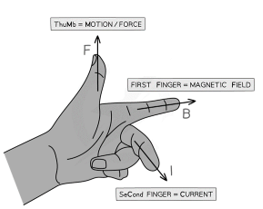
Fleming's left-hand rule is specifically used for motors to determine the direction of force (and thus rotation) on a current-carrying conductor in a magnetic field. According to this rule:
The thumb represents the direction of the force (motion of the conductor).
The forefinger represents the direction of the magnetic field.
The middle finger represents the direction of the current.
When a current flows through the conductor in a magnetic field, a force is exerted on the conductor, causing it to move. Fleming's left-hand rule helps in predicting the direction of this motion, which in turn determines the direction of rotation of the motor.
The other options are not directly applicable for determining the direction of rotation of a DC motor:
Coulomb's Law (a) describes the force between two charges.
Biot-Savart Law (b) describes the magnetic field generated by a current-carrying conductor.
Ampere's Law (d) relates the integrated magnetic field around a closed loop to the electric current passing through the loop.