Correct option is D
Given:
Expression:
Solution:
Expand the terms:
Adding all terms:







Simplify the following expression:
(a + 2b – c) (b – c) + (a – c) 2b +
Given:
Expression:
Solution:
Expand the terms:
Adding all terms:
 English
 100 Questions
 100 Marks
 90 Mins English English100 Questions100 Marks90 Mins English English100 Questions100 Marks90 Mins English
If the angles of a triangle are 4x°, 3x°, 2x° then 1/4x° =
In a triangle, sides are proportional to 7:9:14. If the shortest side is 14 cm, find the perimeter.
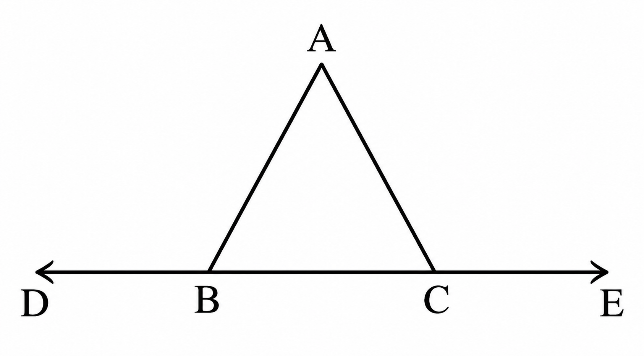
In the given figure, angle ABD = 110 degrees and angle ACE = 125 degrees. What is the value (in degrees) of angle BAC?
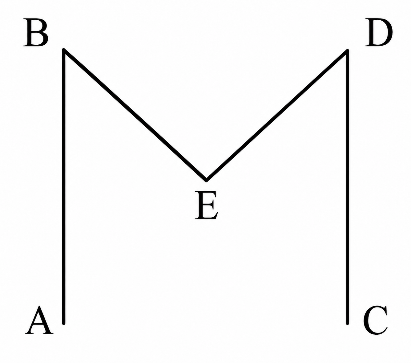
In the given figure, AB is parallel to CD. Angle ABE = 64 degrees and angle CDE = 32 degrees. What is the value (in degrees) of angle BED?
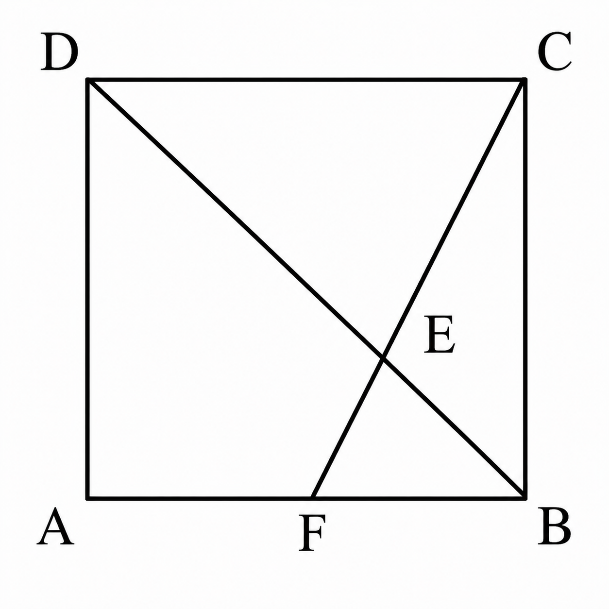
In the given figure, ABCD is a square. Angle DEC = 75 degrees. What is the value (in degrees) of angle EFA?
In a circle with center O, PQ and RS are two chords. PQ and RS, when produced, meet at point K. If PR is a diameter and ∠ PKS = 66°, what is the value of ∠ QOS?
In the given figure, AB is parallel to CD. What is the value (in degrees) of angle BEC?
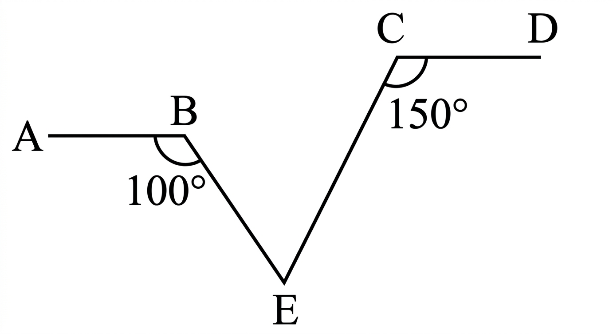
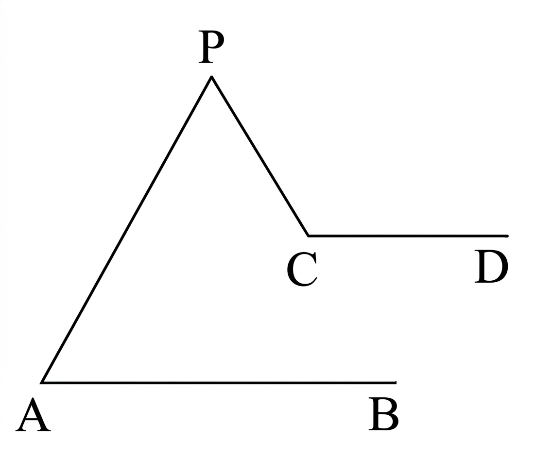
In the given figure, AB is parallel to CD. Angle PAB = 65 degrees and angle DCP = 110 degrees. What is the value (in degrees) of angle APC?
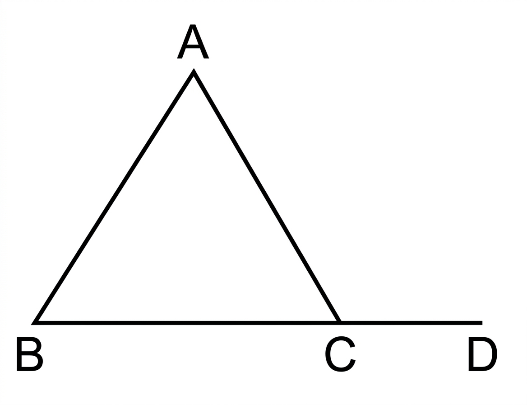
In the given figure, angle ABC = 65 degrees and angle ACD = 120 degrees.
What is the value (in degrees) of angle BAC?


Suggested Test Series

Suggested Test Series
If the angles of a triangle are 4x°, 3x°, 2x° then 1/4x° =
In a triangle, sides are proportional to 7:9:14. If the shortest side is 14 cm, find the perimeter.
In the given figure, angle ABD = 110 degrees and angle ACE = 125 degrees. What is the value (in degrees) of angle BAC?
In the given figure, AB is parallel to CD. Angle ABE = 64 degrees and angle CDE = 32 degrees. What is the value (in degrees) of angle BED?
In the given figure, ABCD is a square. Angle DEC = 75 degrees. What is the value (in degrees) of angle EFA?
In a circle with center O, PQ and RS are two chords. PQ and RS, when produced, meet at point K. If PR is a diameter and ∠ PKS = 66°, what is the value of ∠ QOS?
In the given figure, AB is parallel to CD. What is the value (in degrees) of angle BEC?
In the given figure, AB is parallel to CD. Angle PAB = 65 degrees and angle DCP = 110 degrees. What is the value (in degrees) of angle APC?
In the given figure, angle ABC = 65 degrees and angle ACD = 120 degrees.
What is the value (in degrees) of angle BAC?
