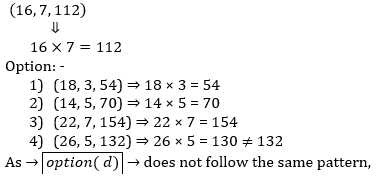
Correct option is D







 English
 80 Questions
 160 Marks
 60 Mins English English80 Questions160 Marks60 Mins English English20 Questions40 Marks25 Mins English
Four triads of numbers have been given out of which three are alike in some manner and one is different. Select the one that is different.
Three of the following four options are alike in a certain way and thus form a group. Which is the option that does NOT belong to that group?
Which roll number is a perfect cube?
Three of the following number-pairs are alike in some manner and hence form a group.
Which number-pair does not belong to that group?
(NOTE: Operations should be performed on the whole numbers, without breaking down the numbers into its constituent digits. E.g. 13 - Operations on 13 such as adding/subtracting/ multiplying etc. to 13 can be performed. Breaking down 13 into 1 and 3 and then performing mathematical operations on 1 and 3 is not allowed.)
Three of the following four are alike in a certain way and thus form a group. Which is the one that does NOT belong to that group?
NOTE: Operations should be performed on the whole numbers, without breaking down the numbers into its constituent digits. E.g. 13 - Operations on 13 such as adding/deleting/ multiplying etc. to 13 can be performed. Breaking down 13 into 1 and 3 and then performing mathematical operations on 1 and 3 is not allowed)
(A) 56-7
(B) 169-13
(C) 729-27
(D) 121-11
Four number-pairs are given, three follow a pattern. Choose the odd pair.


Suggested Test Series

Suggested Test Series
Four triads of numbers have been given out of which three are alike in some manner and one is different. Select the one that is different.
Three of the following four options are alike in a certain way and thus form a group. Which is the option that does NOT belong to that group?
Which roll number is a perfect cube?
Three of the following number-pairs are alike in some manner and hence form a group.
Which number-pair does not belong to that group?
(NOTE: Operations should be performed on the whole numbers, without breaking down the numbers into its constituent digits. E.g. 13 - Operations on 13 such as adding/subtracting/ multiplying etc. to 13 can be performed. Breaking down 13 into 1 and 3 and then performing mathematical operations on 1 and 3 is not allowed.)
Three of the following four are alike in a certain way and thus form a group. Which is the one that does NOT belong to that group?
NOTE: Operations should be performed on the whole numbers, without breaking down the numbers into its constituent digits. E.g. 13 - Operations on 13 such as adding/deleting/ multiplying etc. to 13 can be performed. Breaking down 13 into 1 and 3 and then performing mathematical operations on 1 and 3 is not allowed)
(A) 56-7
(B) 169-13
(C) 729-27
(D) 121-11
Four number-pairs are given, three follow a pattern. Choose the odd pair.
