

arrow
arrow
arrow
Rivers A and B with constant water speeds a and b merge at point P to form river C with a constant water speed c.A boat having speed s in still water
Question

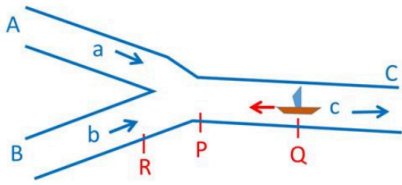
Rivers A and B with constant water speeds a and b merge at point P to form river C with a constant water speed c.

A boat having speed s in still water would reach point R from Q only ifs is more than.

A.

minimum of a, b and c

B.

maximum of b and c

C.

mean of a and b

D.

mean of b and c.

Correct option is B

Given:
Rivers A and B merge at point P to form river C.
Water speeds:
River A = a
River B = b
River C = c
A boat travels from Q to R (against the current of river C, and then against river B’s flow).
Boat speed in still water = s

Solution:
When a boat goes upstream, the effective speed of the boat is s − water speed.

If the boat wants to move against the current, its speed s must be greater than the speed of the river current.

Here:

From Q to P → the boat moves upstream in river C, so it must have s > c

From P to R → the boat moves upstream in river B, so it must have s > b

Therefore:
The boat must have speed greater than both b and c, i.e.,
s must be greater than max(b, c)

Final Answer:
S. Ans. = maximum of b and c

Similar Questions

test-prime-package

Access ‘CSIR NET- GENERAL APTITUDE’ Mock Tests with

  • 60000+ Mocks and Previous Year Papers
  • Unlimited Re-Attempts
  • Personalised Report Card
  • 500% Refund on Final Selection
  • Largest Community
students-icon
354k+ students have already unlocked exclusive benefits with Test Prime!
test-prime-package

Access ‘CSIR NET- GENERAL APTITUDE’ Mock Tests with

  • 60000+ Mocks and Previous Year Papers
  • Unlimited Re-Attempts
  • Personalised Report Card
  • 500% Refund on Final Selection
  • Largest Community
students-icon
354k+ students have already unlocked exclusive benefits with Test Prime!
Our Plans
Monthsup-arrow
