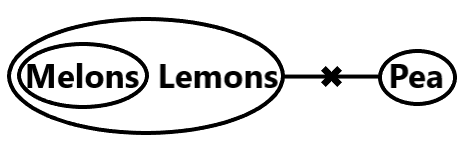
Correct option is B
1. All melons are lemons.
2. No lemon is a pea.

I. No lemon is a melon. (False, all melons are lemons).
II. No melon is a pea. (True, there is no relation between melon and pea).
Read the given statements and conclusions carefully. Assuming that the information given in the statements is true, even if it appears to be at variance with commonly known facts, decide which of the given conclusions logically follow(s) from the statements.
Statements:
1. All melons are lemons.
2. No lemon is a pea.
Conclusions:
I. No lemon is a melon.
II. No melon is a pea.

Read the given statements and conclusions carefully. Assuming that the information given in the statements is true, even if it appears to be at variance with commonly known facts, decide which of the given conclusions logically follow(s) from the statements.
Statements:
1. All geysers are fans.
2. No fan is a refrigerator.
Conclusions:
I. No geyser is a refrigerator.
II. Some refrigerators are fans.
Read the given statements and conclusions carefully. Assuming that the information given in the statements is true, even if it appears to be at variance with commonly known facts, decide which of the given conclusions logically follow(s) from the statements.
Statements:
1. All markers are pens.
2. All markers are sketches.
3. All markers are chalks.
Conclusions:
I. All pens are chalks.
II. Some chalks are sketches.
Read the given statements and conclusions carefully. Assuming that the information given in the statements is true, even if it appears to be at variance with commonly known facts, decide which of the given conclusions logically follow(s) from the statements.
Statements:
1. All melons are lemons.
2. No lemon is a pea.
Conclusions:
I. No lemon is a melon.
II. No melon is a pea.
Three statements are given, followed by three conclusions (I), (II), and (III). You have to take these statements to be true, even if they seem to be at variance from commonly known facts. Decide which of the given conclusions logically follows from the given statements.
Statements:
Some flowers are trees
All trees are gardens
All gardens are jungles
Conclusions:
(I) Some jungles are flowers
(II) All gardens are trees
(III) Some jungles are trees
Three statements are given, followed by three conclusions (I), (II), and (III). You have to consider these statements to be true, even if they seem to be at variance from commonly known facts. You are to decide which of the given conclusions logically follow(s) from the given statements.
Statements:
(1) No chair is table
(2) Some benches are tables
(3) All chairs are Almirahs
Conclusions:
(I) Some Almirahs are tables
(II) Some benches are chairs
(III) No table is Almirah
Three statements are given followed by three conclusions (I), (II) and (III). You have to take these statements to be true, even if they seem to be at variance from commonly known facts. Decide which of the given conclusions logically follow(s) from the given statements.
Statements:
(1) All books are papers
(2) All pens are papers
(3) All pencils are pens
Conclusions:
(I) All pencils are papers
(II) Some pencils are books
(III) Some papers are pencils
Suggested Test Series